


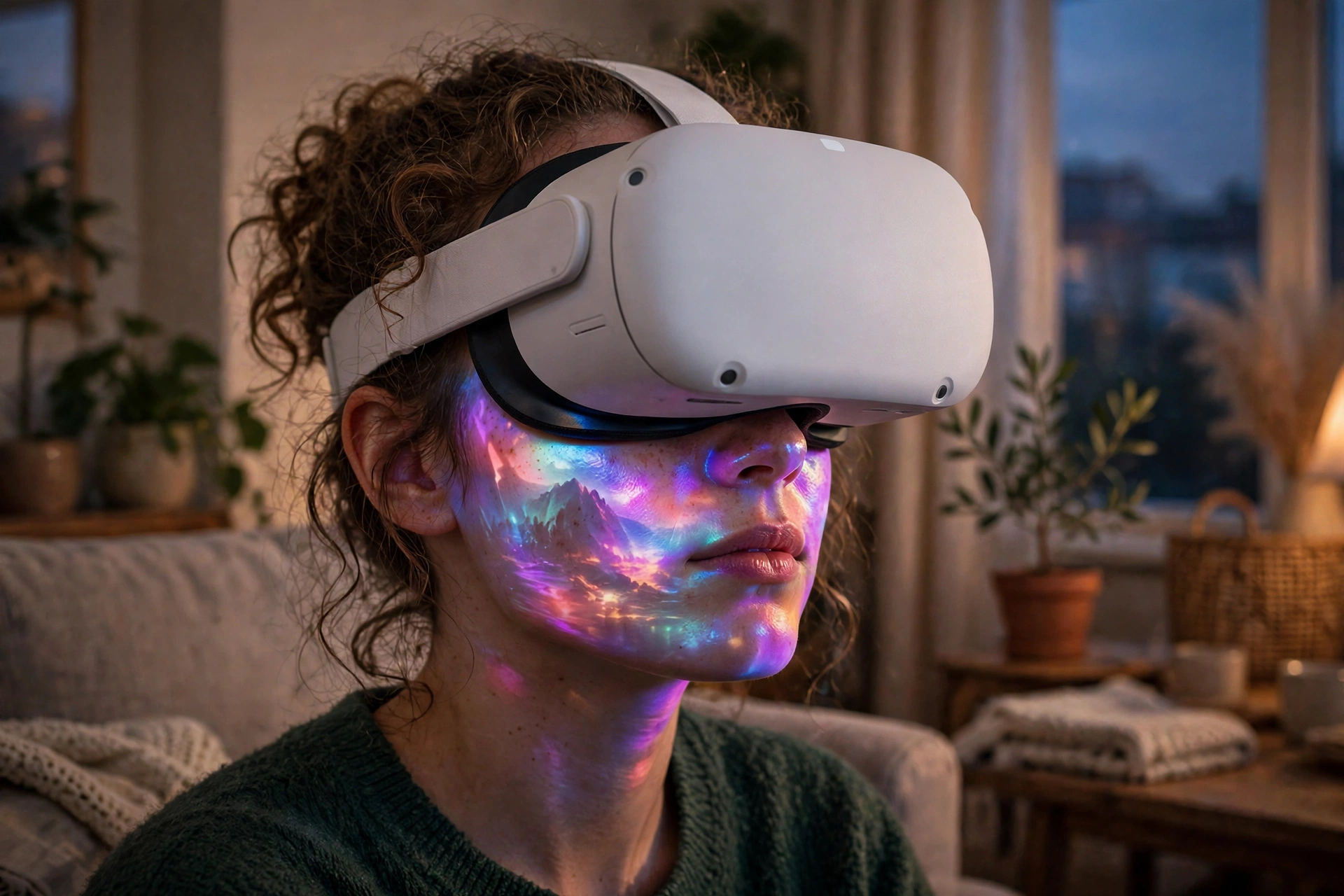
If you have ever tried a face filter on your phone and then watched someone disappear into a virtual reality headset, you have already met both sides of augmented reality vs virtual reality. People mix the two up all the time, and the tech world has not helped — brands slap “AR” and “VR” on everything from games to glasses to meeting apps. The real difference is simple: one adds to the world around you, and the other replaces it completely. This guide covers augmented reality vs virtual reality in plain language — what each one is, what gear you need, where each one works best, and which one to try first.

Table of Contents
Augmented Reality vs Virtual Reality: The Core Difference
Here is the one-sentence version of augmented reality vs virtual reality: AR layers digital things on top of your real surroundings, while VR shuts the real world out and drops you into a fully digital one.
Think of AR like a transparent sticker on a window. You still see the street outside, but now there is extra information floating on the glass — directions, a 3D sofa, or a cartoon character on your coffee table. Your living room stays your living room.
VR is the opposite move. You put on a headset, the screens cover your eyes, and your living room is gone. You could be on a beach, inside a spaceship, or in a virtual classroom with people from three countries. The headset tracks your head, so when you turn, the world turns with you. That sense of “being there” is the whole point.
That single difference — adding versus replacing — drives everything else: the hardware, the price, the best uses, and the problems each one runs into.
What Augmented Reality Actually Does
On the AR side of augmented reality vs virtual reality, everything starts with a camera. Your phone, tablet, or smart glasses look at the real world, work out where surfaces and objects are, and draw digital content on top of that view in real time.
You have probably used AR without realising it had a name. Face filters on social apps are AR, the “view in your room” button on furniture websites is AR, and navigation apps that paint arrows onto the road ahead through your camera are AR.
Because AR works on a phone you already own, it is the easiest side of augmented reality vs virtual reality to try. There is nothing extra to buy, no headset to charge, and no space to clear. You point your camera, and the digital layer appears. For shops, that low barrier is a big deal: a buyer can see how a lamp looks on their own desk before spending money, which cuts down on wrong orders and returns.
The trade-off is that phone-based AR is limited. The screen is small, the digital objects only exist inside that rectangle, and the illusion breaks the moment you lower the phone. Smart glasses fix some of that, but good AR glasses are still pricey and, in 2026, still feel like early hardware.
What Virtual Reality Actually Does
On the VR side of augmented reality vs virtual reality, things go all in. A VR headset blocks out your surroundings with screens, headphones, and motion tracking, and replaces them with a computer-generated environment that responds to you: lean forward and the scene moves closer, reach out and your virtual hand reaches too.
Gaming is where most people meet VR first — a horror or racing game feels completely different when your whole field of vision is inside it. But gaming is only the start. Surgeons practise operations on virtual patients, trainee firefighters walk through burning buildings that cannot hurt them, and students take virtual field trips to ancient Rome or inside a human heart.
The catch is commitment. A decent standalone headset costs several hundred dollars, you need a clear patch of floor, and some people feel dizzy after 20 to 30 minutes — motion sickness, caused by your eyes and inner ear disagreeing about whether you are moving. In the debate over augmented reality vs virtual reality, this is VR’s biggest everyday drawback: it asks more of you than AR does.
Augmented Reality vs Virtual Reality at a Glance
| Feature | Augmented Reality (AR) | Virtual Reality (VR) |
|---|---|---|
| What it does | Adds digital content to the real world | Replaces the real world with a digital one |
| Are you aware of your surroundings? | Yes, fully | No, you are inside the virtual world |
| Main device | Smartphone, tablet, or smart glasses | VR headset and controllers |
| Typical cost to start | Free (your phone) | $300–$1,000+ for a good headset |
| Best for | Shopping, navigation, quick information, everyday help | Gaming, training, simulations, deep experiences |
| Space needed | None | A clear area to move safely |
Neither one is “better” in general. They solve different problems. For another side-by-side breakdown, see this comparison of VR, AR and MR.
The Devices: What You Need for Each
For AR, your phone is the starting point. Apple phones use ARKit and Android phones use ARCore — built-in toolkits that let apps place digital objects in your camera view. Go further and there are AR glasses from companies like Meta and Xreal, plus headsets like the Apple Vision Pro that blend AR and VR. Expect $200 for basic display glasses to well over $3,000 for a top-end mixed device.
For VR, the most popular standalone headsets are the Meta Quest 3 and Quest 3S, which need no computer at all. PlayStation VR2 connects to a PlayStation 5, and high-end PC headsets like the Valve Index need a powerful gaming computer. Standalone headsets are the easiest entry point: charge it, put it on, and you are in.
One practical tip: if you wear glasses, check whether the headset you want works with them or needs prescription lens inserts — a detail buyers often forget when comparing augmented reality vs virtual reality gear.
Where Each Technology Shines
Gaming leans toward VR: a full virtual world is unbeatable for immersion, which is why VR arcades keep growing. This is where the comparison of augmented reality vs virtual reality gets practical — the right choice depends on the job, not the hype.
Education and training use both, in different ways. A medical student can study a 3D heart floating above a textbook with AR, then step inside a virtual operating theatre with VR to practise. A car mechanic can wear AR glasses that overlay repair steps directly onto the engine in front of them.
Shopping is AR’s home turf. Furniture, glasses, makeup, and paint colours can be previewed in your own space before you buy. Confident buyers return fewer items, and guessing is gone.

Healthcare uses both quietly: VR helps patients manage chronic pain and face phobias gradually, while AR lets surgeons see scans overlaid on a patient during a procedure — though results vary by clinic and device.
Augmented Reality vs Virtual Reality: Cost and Accessibility
Cost is where augmented reality vs virtual reality splits most clearly for ordinary buyers. AR is nearly free to start because the phone in your pocket already runs it. VR means buying a headset, and a good standalone headset plus accessories still runs into hundreds of dollars.
Accessibility matters too. AR works for a quick 30-second check — scan a product, get directions, translate a sign. VR needs you to stop what you are doing, clear some space, and put on a headset. Fine for a planned gaming session, but overkill for checking whether a sofa fits your room.
For a beginner on a budget, the smart path is clear: play with AR on your phone first, for free. If full immersion hooks you, then look at a standalone VR headset. For a business, match the tool to the job — AR for quick, everyday help; VR for deep, repeatable training. That cost gap is often the deciding factor in augmented reality vs virtual reality for first-time buyers.
The Downsides Nobody Mentions
Neither technology is perfect, and the marketing rarely shows the rough edges. VR’s biggest one is motion sickness: fast movement in a virtual world can leave your stomach churning, especially in your first few sessions. Short sessions and games with slow movement help most people adjust within a week or two.
AR’s problem is subtler: privacy. An AR device with a camera is always looking at the world around you, including other people, which raises fair questions about recording in public places — and rules differ by country and venue. Battery life is another weak spot for both: a headset that dies mid-session is no fun at all.
There is also the content gap: plenty of games and demos, but genuinely useful everyday apps are still catching up. In short, the trade-offs in augmented reality vs virtual reality are real on both sides — neither one is a flawless purchase.
Mixed Reality: Where the Two Meet
The newest devices blur the line, and this is where the debate about augmented reality vs virtual reality gets interesting. Mixed reality headsets have cameras on the outside, so they can show you your real room — and then place virtual objects inside it that behave like they belong there. A virtual ball can bounce off your real table; a digital screen can hang on your real wall.
Apple’s Vision Pro and Meta’s Quest headsets both do versions of this. Future devices will probably not be “AR or VR” at all, but one headset that slides between the two — AR directions in your kitchen in the morning, full VR for an evening game.
Which One Should You Try First?
If you want my honest take: start with AR, because it costs nothing and you can try it today. Open your phone camera, try a furniture preview app or a translation app that overlays text on signs, and see how it feels. It is genuinely useful, not just a gimmick. If this guide sparked an idea for your own site, our beginner’s guide to creating a blog and earning money walks through publishing your first post.
Then, if you get the chance — at a friend’s house, a store demo, or a VR arcade — try VR for 15 minutes. Pick a calm experience first, not a fast roller-coaster demo. That short taste tells you more than any article can.
For most people, the answer will not be one or the other. You will use AR ten times a day without thinking about it, and VR once a week for something special — not rivals, but two different tools for two different jobs.

Frequently Asked Questions About Augmented Reality vs Virtual Reality
Is augmented reality vs virtual reality the same thing?
No. AR adds digital content to your real surroundings, while VR replaces your surroundings with a completely digital world. They use different hardware and suit different tasks.
Do I need an expensive headset for AR?
No. Most AR runs on a regular smartphone, which you probably already own. Headsets and smart glasses add comfort and a wider view, but they are optional, not required.
Which is better for gaming, AR or VR?
VR, in most cases. Full immersion is what makes VR games feel so different from phone games.
Will one headset eventually do both?
That is already happening. Modern mixed reality headsets let you switch between seeing your real room with digital objects in it and being fully inside a virtual world.
Disclaimer
This article is general educational information about augmented reality vs virtual reality, not professional, technical, or financial advice. Device prices, features, availability, and health-related claims change over time and vary by country, brand, and model. Please verify specifications, prices, and safety guidance from official manufacturer sources before buying any device or relying on any health-related use described here.
To learn more about the site behind this guide, visit the About Us page.
