
A home workout for beginners is the simplest way I know to get moving without joining a gym, buying gear, or rearranging your whole life. You need a patch of floor, about twenty minutes, and a routine you can actually repeat. That is it.
No commute, no monthly fee, no waiting for a machine while someone else finishes their set. That is why a home workout for beginners is such a practical starting point: it asks for twenty minutes and a little floor space, and it gives back strength you can feel in daily life. If you have ever told yourself you would start exercising “next Monday” and then watched next Monday come and go, a home workout for beginners removes almost every excuse in one move: you can do it in your living room, in clothes you already own, at whatever hour suits you.
I started paying attention to home training when I noticed how many people quit the gym in the first month. It was rarely laziness. It was friction. The drive, the changing room, the feeling of being watched, the complicated machines. A home workout for beginners flips that around. You practise in private, you learn a handful of moves properly, and you build the habit first. Strength and stamina follow the habit, not the other way round.
Table of Contents
Why a Home Workout for Beginners Works So Well
The biggest advantage is consistency. Research and public-health guidance keep pointing to the same conclusion: adults should aim for around 150 minutes of moderate activity a week, plus muscle-strengthening work on two or more days. That sounds like a lot until you break it down. Three 20-minute sessions plus a few brisk walks already gets you close. A home workout for beginners fits that pattern neatly, because a short session at home is far easier to repeat than a long session that depends on traffic, weather, and opening hours. A home workout for beginners also pairs well with walking, so the weekly activity target stops feeling like a mountain and starts feeling like a routine.
There is also the form factor. Bodyweight moves train you to control your own body through space, which builds practical strength: standing up from a chair, carrying shopping bags, climbing stairs without getting winded. You are not isolating one muscle on a machine. You are teaching your legs, hips, core, and shoulders to work together, which is exactly what daily life asks of them. That practical strength is the real prize of a home workout for beginners, more than any number on a scale.
And there is the cost, which is zero. No membership, no dumbbells, no special shoes to start with. A folded towel on the floor works fine instead of a mat, and a sturdy chair or a wall gives you support for the easier versions of each move. If you later decide you enjoy training, you can add a resistance band or a pair of dumbbells. You do not need them on day one, and buying them before you have a habit is usually money spent on good intentions. For more beginner ideas, see Nuffield Health’s guide to at-home workouts for beginners.
What You Need for a Home Workout for Beginners
Almost nothing, but a little preparation makes the first week much smoother:
- A clear space about the size of a yoga mat, roughly six feet by three feet, where you can lie down and stretch your arms without hitting furniture.
- Comfortable clothes you can move in and a bottle of water nearby.
- A sturdy chair and a clear stretch of wall for the easier push-up and squat versions.
- A phone timer, so you are not guessing how long you have held a plank.
That is the whole kit list. If your space is small, it still works. I have seen people train in a corner of a bedroom barely bigger than a prayer mat. What matters is that the space is clear and safe, not that it looks like a gym. Once your space is set, a home workout for beginners can start within a minute of deciding to train, which is exactly why the habit sticks.
One honest note before you start: this guide is general information, not medical advice. If you have a heart condition, chest pain, dizziness, a recent injury or surgery, or a chronic health condition, check with a doctor before starting a new exercise routine. Stop any move that causes sharp pain, and treat mild muscle soreness the next day as normal, not as a badge of honour.
The 6 Moves in This Home Workout for Beginners
You only need six moves. Learn them slowly, and do not rush to harder versions. Each move below belongs in any solid home workout for beginners plan, and together they cover your legs, chest, back, core, and balance. Good form on an easy move beats sloppy form on a hard one every time.
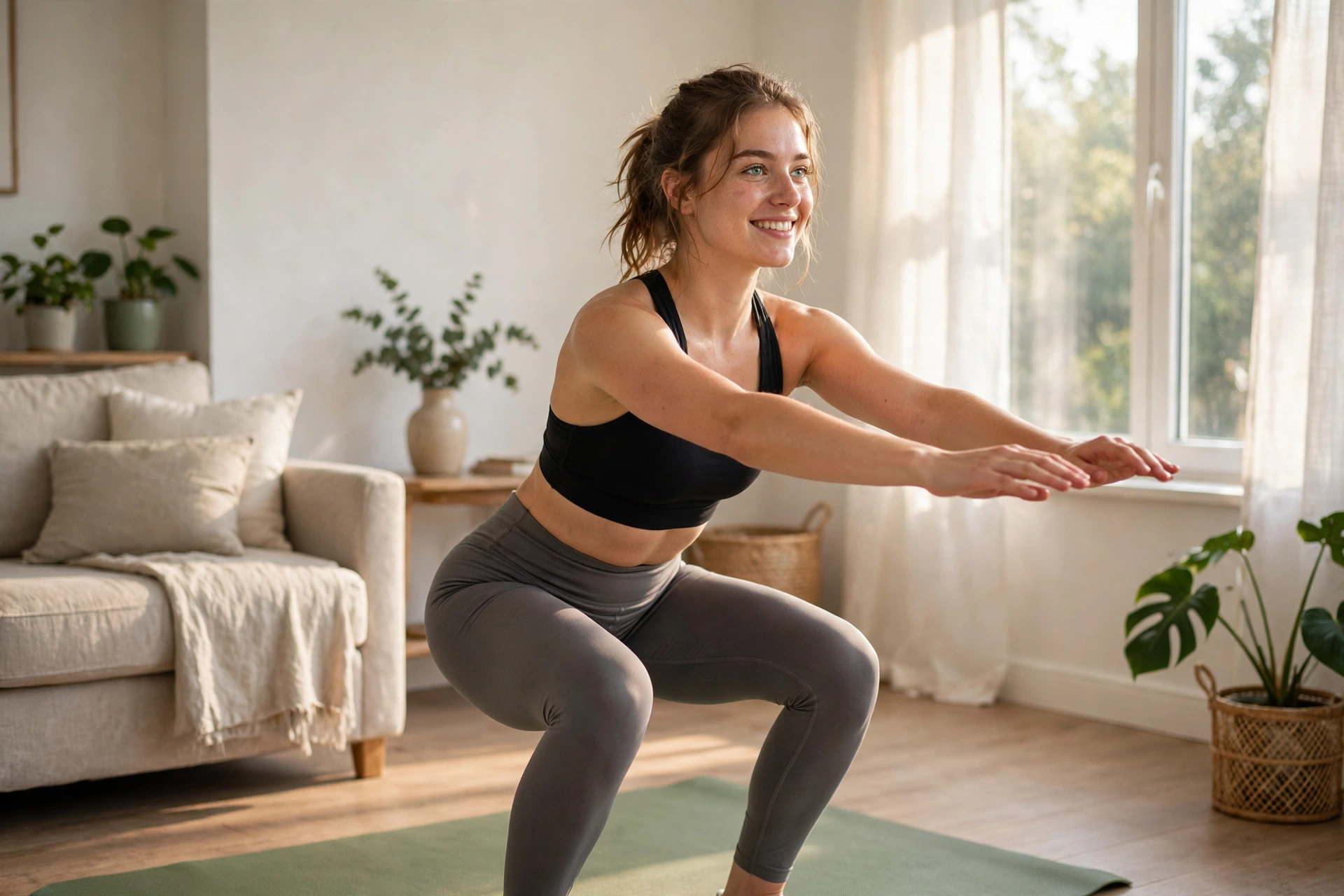
1. Bodyweight squat
Stand with your feet shoulder-width apart, toes turned slightly out. Push your hips back as if you are sitting into a chair, keep your chest up, and lower until your thighs are roughly parallel to the floor. Press through your heels to stand. If this feels shaky, hold a chair for balance or squat to a chair and stand back up. Start with 10 slow repetitions.
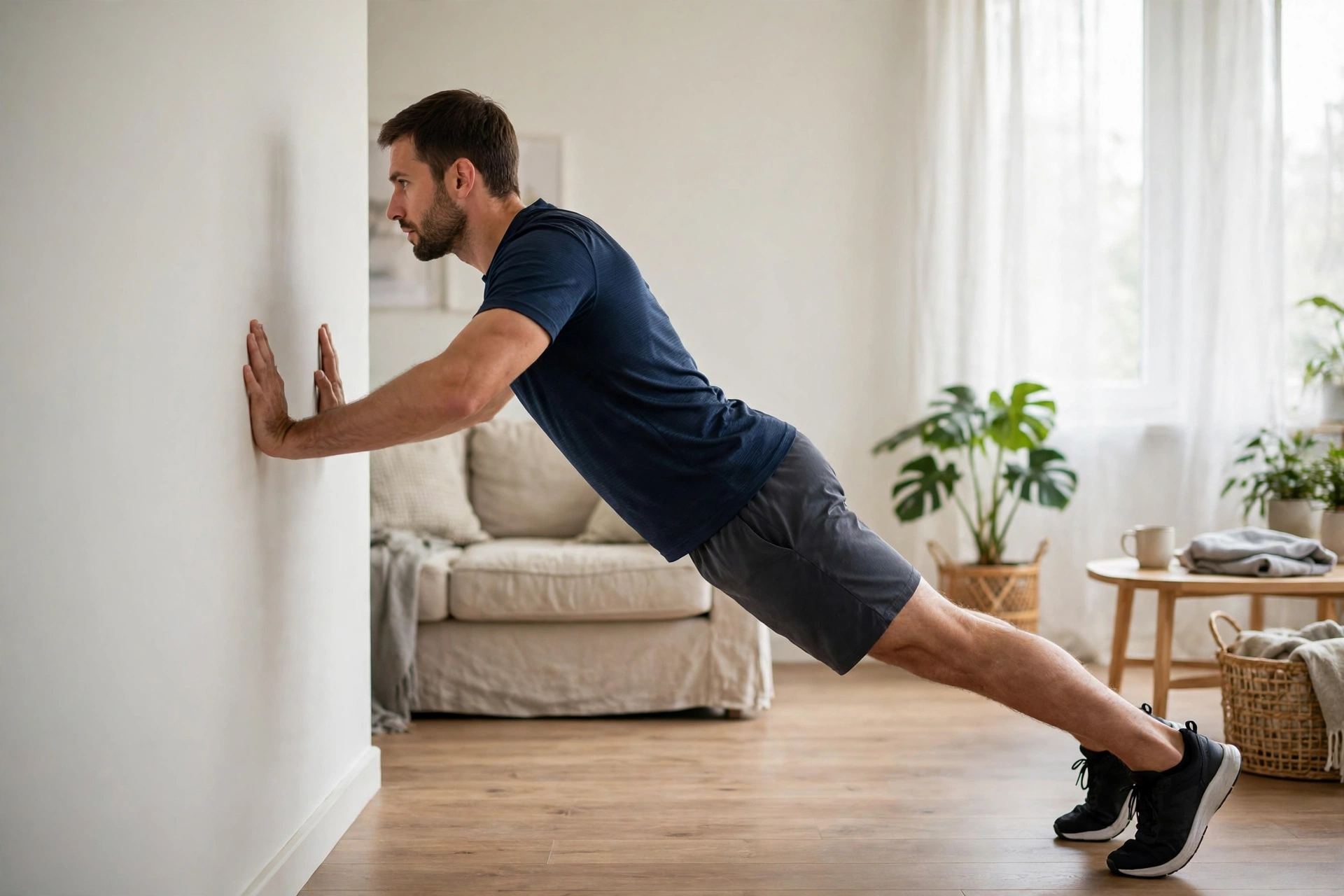
2. Wall or incline push-up
Stand facing a wall, place your palms flat against it at shoulder height, and step back until your body is at a slight angle. Bend your elbows, bring your chest towards the wall, and push back. Keep your body in one straight line from head to heels. As you get stronger, move your hands to a lower surface, like a kitchen counter, and eventually to the floor on your knees. Start with 8 to 10 repetitions.
3. Glute bridge
Lie on your back with your knees bent and feet flat on the floor. Press through your heels and lift your hips towards the ceiling until your body forms a straight line from shoulders to knees. Pause for a second, then lower slowly. This strengthens your glutes and lower back without any equipment at all. Start with 12 repetitions.
4. Reverse lunge
Stand tall, step one foot back, and lower until both knees are bent at roughly right angles. Your front knee should stay above your ankle, not drift far past your toes. Push through your front foot to return to standing, then switch legs. Hold a chair if your balance wobbles. Start with 8 repetitions on each leg.
5. Bird-dog
Start on your hands and knees, wrists under shoulders and knees under hips. Slowly extend your right arm forward and your left leg back, keeping your hips level and your back flat. Hold for two seconds, return, and switch sides. This is a quiet move that does a lot: core stability, balance, and back control. Start with 6 repetitions on each side.
6. Knee plank
Lie face down, then prop yourself on your forearms and knees, keeping your body straight from head to knees. Do not let your hips sag or pike up. Breathe normally. If a full plank on your toes is comfortable, use that instead, but the knee version is a perfectly respectable starting point. Start with a 20-second hold.
The routine at a glance
| Exercise | Reps or time | Rest after |
|---|---|---|
| Bodyweight squat | 10 | 30 seconds |
| Wall or incline push-up | 8 to 10 | 30 seconds |
| Glute bridge | 12 | 30 seconds |
| Reverse lunge | 8 each leg | 30 seconds |
| Bird-dog | 6 each side | 30 seconds |
| Knee plank | 20 seconds | 60 seconds |
Do the six moves in order, resting as shown. That is one round. Repeat this circuit for a home workout for beginners session that stays under half an hour even at three rounds. Beginners should start with one round and build to two or three over a few weeks.
Your First Home Workout for Beginners Session, Step by Step
Here is exactly what your first session looks like, start to finish, in about 20 minutes:
Warm up (5 minutes). March in place for a minute, swing your arms in big circles for 30 seconds each way, roll your shoulders, circle your hips, and do five slow sit-to-stands from a chair. Warm muscles feel looser, and the whole session feels easier. Skipping this is the fastest way to make a workout feel harder than it is.
Work (10 minutes). Do one round of the six moves above, resting 30 seconds between moves. Move slowly. Count your repetitions out loud if it helps you stay steady. If a move feels too easy, slow it down rather than rushing through extra repetitions. Slow squats are surprisingly humbling.
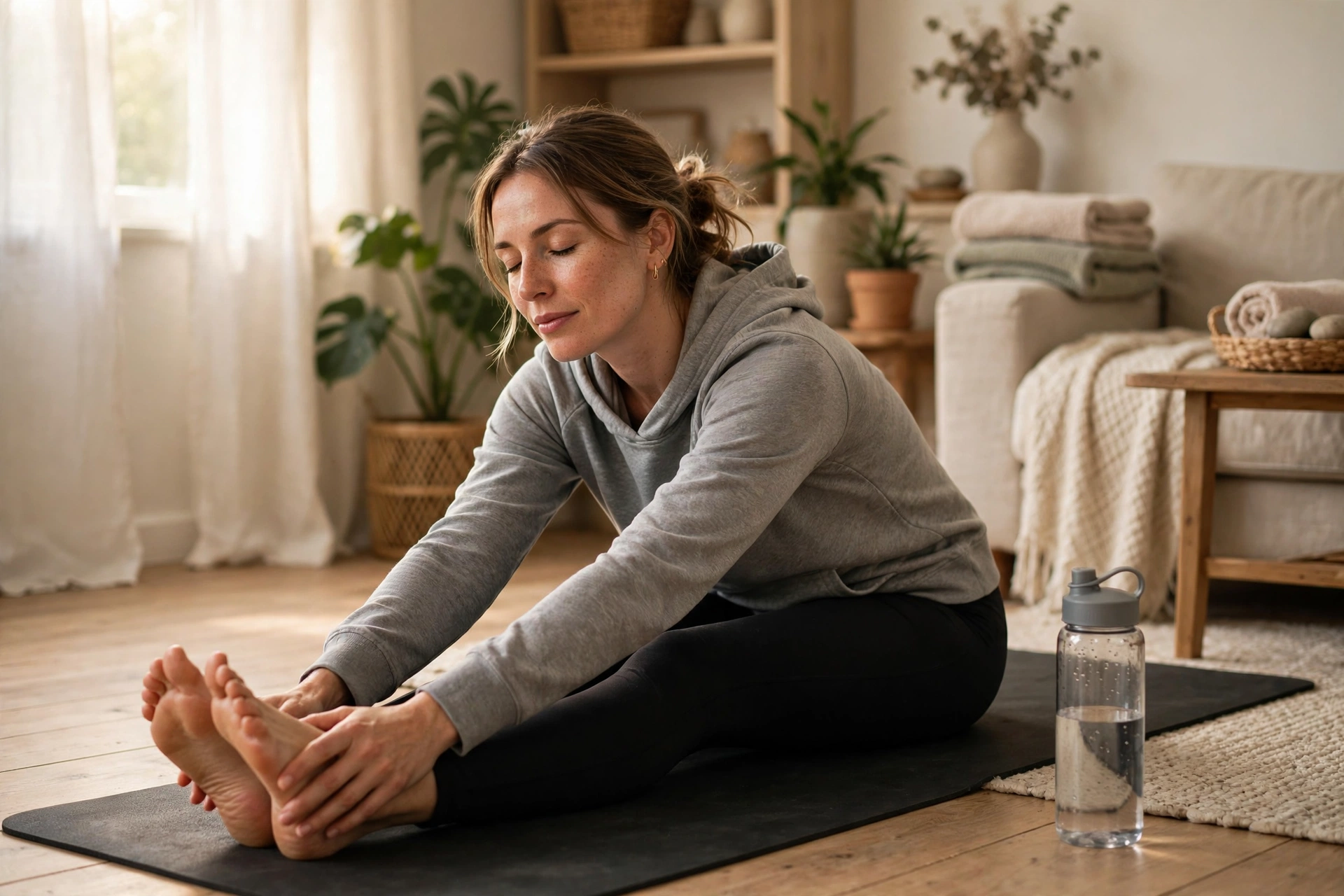
Cool down (5 minutes). Walk slowly around the room for a minute, then hold gentle stretches for your calves, thighs, hip flexors, and chest for 20 to 30 seconds each. Breathe slowly. This is also the moment to notice how you feel: pleasantly tired is good, exhausted is a sign you pushed too hard.
That is your first session done. That first session is a proper home workout for beginners session, even though it felt short, because you warmed up, trained your whole body, and cooled down.
It will probably feel easier than you expected, and that is the point. Week one is about learning the moves and proving to yourself that you can show up three times. The soreness that arrives the next day is normal, especially in your thighs after the squats. It usually fades within two or three days, and it fades faster once your body gets used to the routine. A home workout for beginners should leave you pleasantly tired, not wrecked, and that feeling is how you know the dose was right.
A 4-Week Home Workout for Beginners Plan
Progress in a home workout for beginners does not come from heroic single sessions. It comes from small, weekly increases. Add a round, add a few repetitions, or shorten your rests slightly. Never increase everything at once. In a home workout for beginners plan, one small increase per week is plenty, and it is the increase you can repeat that counts.
| Week | Sessions | Rounds | Notes |
|---|---|---|---|
| Week 1 | 2 to 3 | 1 | Learn the moves, focus on form |
| Week 2 | 3 | 1 to 2 | Add a second round on your strongest day |
| Week 3 | 3 | 2 | Shorten rests to 20 to 30 seconds |
| Week 4 | 3 | 2 to 3 | Try a harder version of one move |
On the days between sessions, take a brisk walk or do gentle stretching. Walking counts. The public-health target of 150 minutes a week is much easier to reach when walking and short workouts are combined, and walking on rest days keeps you moving without tiring the same muscles.
After four weeks, you have a decision to make, and it is a good one: keep adding rounds, try harder versions of the moves (floor push-ups instead of wall push-ups, full planks instead of knee planks, split squats instead of reverse lunges), or add a fourth weekly session. A home workout for beginners plan works best when week five looks only slightly harder than week four, not completely different. Any of those is progress. What you should not do is jump straight to an advanced programme you found online. The people in those videos have usually trained for years.
Common Mistakes That Stall a Home Workout for Beginners
Starting too hard. The classic beginner error is turning day one into a test. Two rounds of everything, jumping exercises, no warm-up, and then three days of soreness that kills the habit. Start easy enough that you finish feeling you could have done a little more. A home workout for beginners that ends with energy left over is a success, because it makes tomorrow’s session something you look forward to rather than dread.
Copying advanced routines. Social media is full of impressive home workouts, but many are designed for people who already train. A routine with burpees, jump squats, and pistol squats is not a beginner routine just because it is filmed in a living room.
Skipping rest days. Muscles get stronger while you recover, not while you train. Three sessions a week with rest days between them beats six sessions in a row followed by a week off. If you are still very sore, take an extra rest day. It is not quitting.
Holding your breath. Beginners often hold their breath during hard moves, especially planks. Breathe steadily. If you cannot breathe and move at the same time, the move is too hard in its current version. Make it easier.
Judging the workout by sweat. Sweat measures temperature and effort, not quality. A slow, controlled session with good form can leave you barely sweaty and still be exactly the right workout.
How to Stay Consistent When Motivation Fades
Motivation is unreliable, so build the routine around things that do not depend on it. Pick the same three days each week, for example Monday, Wednesday, and Friday, and the same time of day. A home workout for beginners becomes automatic fastest when it has a fixed slot, so protect that slot the way you would protect any other appointment. Lay out your workout clothes the night before. Keep your space clear so starting takes less than a minute. And track your sessions with a simple tick on a calendar or a note on your phone. After two weeks of ticks, skipping a session starts to feel like breaking a chain, and that feeling is more reliable than motivation.
It also helps to make the session enjoyable rather than grim. Put on music you like, open a window, or train with a family member. Some people pair their workout with a habit they already have, like exercising right after their morning tea. The pairing matters more than the playlist: when the tea is finished, the workout starts, and no daily decision is needed.
If you miss a week, do not try to make it up with a double session. A home workout for beginners survives a missed week easily, because the next session is always just twenty minutes away. Just do the next scheduled session. A missed week is a pause, not a failure, and every long-term exerciser has had them. The people who keep training for years are not the ones who never miss a session. They are the ones who return after missing one. Readers with a packed calendar may also like our guide on fitness tips for busy professionals.
Frequently Asked Questions
Do I really not need any equipment for a home workout for beginners?
No. Every move in this guide uses your bodyweight, plus a chair or a wall for support. A mat is nice for comfort on floor moves, but a folded towel or a rug works just as well. You can add equipment later if you want variety, but nothing here requires a purchase.
How many days a week should a beginner work out at home?
Three days a week is the sweet spot for most beginners, with at least one rest day between sessions. If three feels like too much at first, start with two. Two sessions a week, done consistently for a month, beats four sessions in one week followed by nothing. A home workout for beginners done twice a week for a month is real progress, and you can add the third day once the habit feels solid.
How long should a home workout for beginners last?
About 20 minutes is plenty to start with, including warm-up and cool-down. As you add rounds, sessions will grow to 25 or 30 minutes. You do not need hour-long sessions to make real progress in your first months.
Will bodyweight exercises actually build strength?
Yes, for a beginner they absolutely will. Your bodyweight is real resistance, and movements like squats, push-ups, and lunges load the major muscle groups effectively. Progress comes from adding repetitions, rounds, and harder versions over time. At some point, experienced trainees may want extra resistance, but that point is months away, not week one.
What if I cannot do a push-up at all?
Start with wall push-ups, which almost everyone can do. When those feel easy, move to a lower surface like a counter, then to knee push-ups on the floor, then to full push-ups. This ladder works because each step is only slightly harder than the last. There is no shame in the wall version. It is the correct starting point, not a consolation prize.
Disclaimer
This article is general educational information only and is not professional, medical, or fitness advice. Exercise needs and limits vary from person to person, and details such as public-health guidelines, recommendations, and programme structures change over time. Readers should verify current guidance from official sources and consult a qualified professional before starting a new exercise routine, especially if they have a health condition, injury, or any concern about exercising safely.
If this home workout for beginners guide helped you start, keep it simple, keep showing up, and let the results build week by week.
To learn more about the site behind this guide, visit the About Us page.