

I first heard about scalping from a friend who traded during his lunch break. He was not chasing one big win. He was taking ten small ones, closing each trade in a few minutes, and stopping for the day while he was still ahead. That picture stuck with me, because it looked nothing like the slow, patient investing I already knew. If you are curious about this fast style of trading, this guide on scalping trading for beginners will walk you through what it is, what it costs, and how to practise it without risking money you cannot afford to lose.
Let me be honest up front: scalping is exciting, but it is also hard work. That is the promise and the warning of scalping trading for beginners in one sentence: speed rewards discipline and punishes haste. You need focus, a clear plan, and strict rules. Most beginners lose money at first, and anyone who promises easy daily profits from scalping should not be trusted. Used the right way, though, it can teach you more about price movement, discipline, and risk in one month than slower styles teach in a year.
Table of Contents

What Is Scalping Trading for Beginners?
Scalping is a short-term trading style where you open and close positions within seconds or minutes, aiming to profit from very small price moves. In short, scalping trading for beginners means many small, planned trades instead of one large, hopeful trade. A scalper might buy a stock, a currency pair, or a crypto asset, wait for a tiny rise of a few cents or pips, and sell at once. Then they repeat the process, sometimes 10, 20, or even 50 times in a single session.
The idea is simple: small wins, added up, can become a decent result — if your costs stay low and your losses stay smaller than your wins. That last part is where most beginners struggle. A single careless loss can wipe out a whole morning of small gains, so scalping trading for beginners is really a lesson in control first and profit second.
Scalping works best in liquid markets, where lots of buyers and sellers are active and the gap between the buy price and the sell price, called the spread, stays tight. That is why scalping trading for beginners starts with liquid markets, not exotic ones. Popular currency pairs like EUR/USD, large-company stocks, and major crypto pairs are common choices. Quiet, thinly traded assets are a poor fit, because you may not be able to exit quickly at a fair price.
How Scalping Trading for Beginners Actually Works
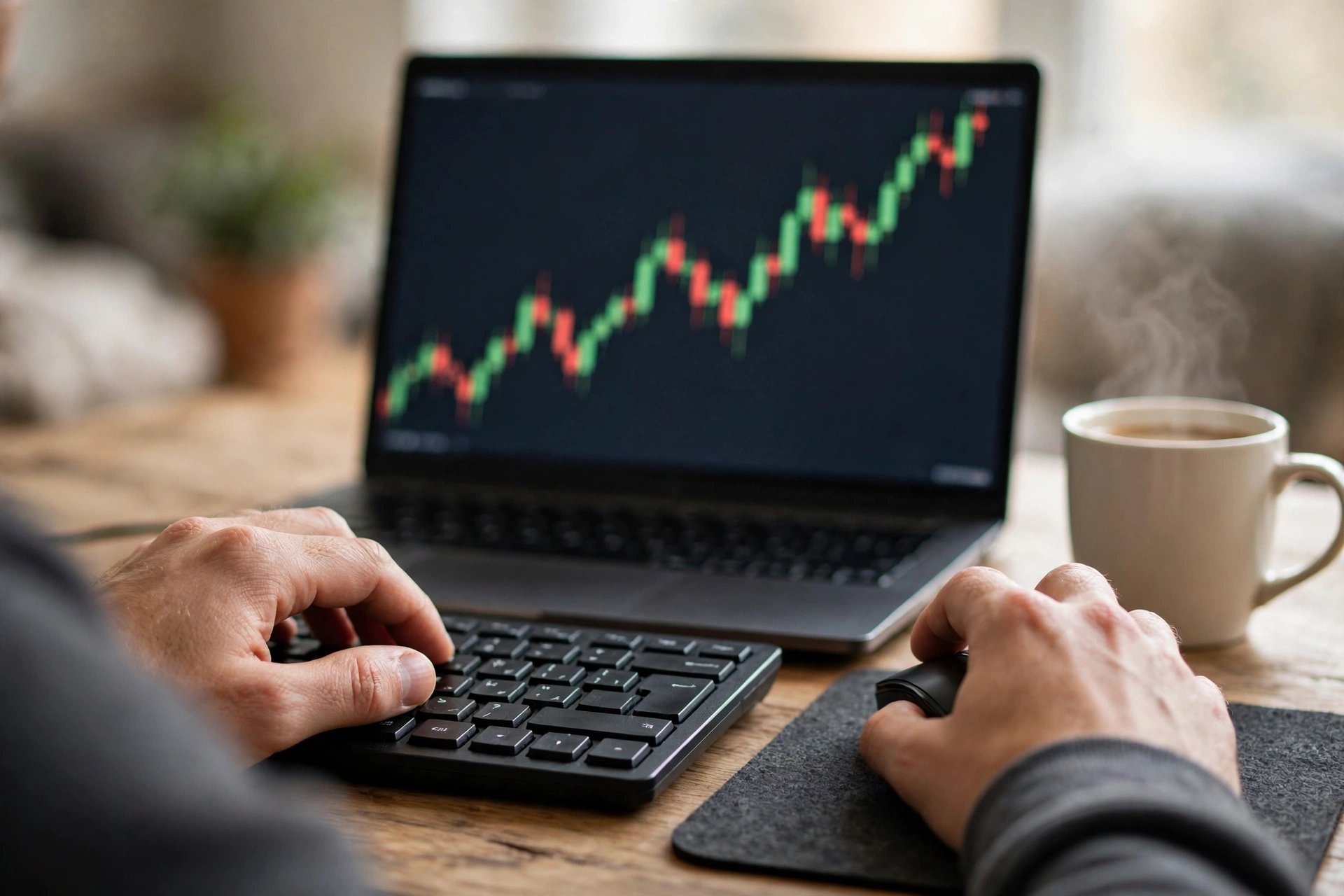
Picture a 1-minute chart. Each candle shows one minute of price action. A scalper watches that chart, plus a 5-minute chart for context, and waits for a setup they have practised many times. When the setup appears, they enter with a pre-set stop-loss and a pre-set target. If the price hits the target, they take the small profit. If it hits the stop, they exit without arguing with the market. Every rule in scalping trading for beginners exists to make that exit automatic, not emotional.
A typical scalping day might look like this. You trade for 60 to 90 minutes during a busy market session, take 8 to 12 trades, and risk no more than 1% of your account on any single trade. Say your account is $500. One percent is $5. That means even five losing trades in a row cost you $25, not your whole account. This kind of maths keeps you in the game long enough to learn.
In scalping trading for beginners, costs are not a footnote; they decide whether a strategy survives. Costs matter more here than in any other style. Every trade pays a spread, and sometimes a commission. If your average win is $4 but your spread and fees cost $1.50 per trade, more than a third of your gross profit is gone before you start. That is why experienced scalpers pick low-cost brokers, trade only liquid instruments, and count costs in their journal after every session.
The Tools You Need for Scalping Trading for Beginners
You do not need an expensive setup to begin, but you do need a few basics that actually work under pressure. A stable internet connection comes first. A frozen screen during a 60-second trade is not a minor annoyance; it can turn a small planned loss into a large one.
A fast, reliable trading platform is next. Most beginners start with MetaTrader 4 or MetaTrader 5, TradingView for charts, or their broker’s own app. Whichever you choose, learn its hotkeys before you trade real money. You should be able to place an order, set a stop-loss, and close a position in seconds, without hunting through menus.
For scalping trading for beginners, a clean chart beats a crowded one every time. Keep your charts clean. Two or three tools are enough: a short moving average such as the 9-period EMA, the VWAP line that shows the day’s average price, and the RSI to warn you when a move looks stretched. Five indicators on one screen will slow your decisions down, and in scalping, slow decisions cost money. For a clear outside explanation of the basics, read the CFI guide to what scalping is and how it works. Read it before you risk money, because scalping trading for beginners goes wrong fastest when the basics are skipped.
7 Steps to Start Scalping Trading for Beginners
Step 1: Learn the basics on a demo account
Open a free demo account with a broker you trust and practise for at least two weeks. Treat the demo balance like real money. If you cannot follow your rules with fake money, you will not follow them with real money either.
Step 2: Pick one market and one session
Choose one instrument, such as EUR/USD or one liquid stock, and one busy time window, such as the London-New York overlap for forex or the first hour after the stock market opens. One market, studied deeply, beats five markets skimmed lightly.
Step 3: Choose one strategy and write it down
Pick one of the strategies below. Write its entry rule, exit rule, stop-loss rule, and maximum trades per day on one page. If a setup does not match that page exactly, skip it. Skipping a trade is a skill, not a failure. That one page is the backbone of scalping trading for beginners who want consistency.
Step 4: Set your risk rules before you trade
Decide your per-trade risk (1% is a sensible start), your daily loss limit (for example, 3% of your account), and your daily profit target. When you hit either limit, stop for the day. No exceptions, even when you feel sure the next trade will win.
Step 5: Practise the mechanics until they are boring
Place 50 demo trades with your chosen strategy. Time yourself. You want order entry, stop placement, and exits to feel automatic. Boring execution is good execution in this style.
Step 6: Start tiny with real money
When your demo results are steady over two weeks, start with the smallest position size your broker allows. Your first goal with real money is not profit; it is proving you can follow your plan while real emotions are involved.
Step 7: Review every session in a journal
After each session, write down your trades, your costs, and one mistake you will fix tomorrow. This slow build is the safest path in scalping trading for beginners, because it separates learning from losing. Traders who journal improve far faster than traders who just remember their wins and forget their losses. Our earlier guide to paper trading explains how to practise safely before risking real capital, and it pairs well with this plan.
Scalping vs Day Trading vs Swing Trading
Before choosing, remember that scalping trading for beginners demands more screen time than the other styles in this table. This table explains why scalping is not for everyone. If you cannot give a session your full attention, a slower style will suit you better, and there is nothing wrong with that choice.
| Style | Holding time | Trades per day | Time needed | Best for |
|---|---|---|---|---|
| Scalping | Seconds to minutes | 10 to 50 | 1 to 2 focused hours | Traders who enjoy fast decisions and strict routines |
| Day trading | Minutes to hours | 1 to 5 | 2 to 4 hours | Traders who want fewer, larger intraday moves |
| Swing trading | Days to weeks | A few per week | 30 minutes a day | Traders with jobs who cannot watch charts all day |
Three Simple Strategies for Scalping Trading for Beginners
1. The EMA pullback
Wait for the price to trend in one direction on the 5-minute chart, then look for a brief pullback to the 9-period EMA on the 1-minute chart. Enter in the direction of the trend, with a tight stop just beyond the pullback low. Take profit at the recent high. Skip the trade if the pullback is deep or messy.
2. The range bounce
Some instruments move sideways for hours between a clear support level and a clear resistance level. Buy near support, sell near resistance, and stop out if the price breaks out of the range. This works best when the range is wide enough to cover your spread and fees at least twice over.
3. The VWAP bounce
When the price dips below the VWAP line during an uptrend and then climbs back above it, that reclaim can be a short scalp entry. Keep the target small, often just a few pips or cents, and exit at the first sign of weakness. Chasing a VWAP trade after it has already run is one of the classic beginner errors.
Test each strategy on demo for at least 20 trades before judging it. That testing habit is what turns scalping trading for beginners from guessing into a repeatable process. One winning day proves nothing. Twenty trades start to show whether your entries, stops, and costs make sense together.
Risk Management in Scalping Trading for Beginners
Risk control is the whole game in scalping, so it deserves its own section. The 1% rule is your first guardrail: never risk more than 1% of your account on one trade while you are learning. The daily stop is your second: if you lose 3% in a day, close the platform and walk away. Revenge trading, where you trade bigger to win back losses, is how small accounts get wiped out in an afternoon.
Position size is where beginners go wrong most often. A $10 stop on a $500 account is 2%, which is already double the beginner guideline. Work the maths before you enter: position size equals the amount you are willing to risk divided by the distance to your stop. Write that number down, set the stop the moment you enter, and never move a stop further away because you hope the price will come back.
Overtrading is a quieter risk. Taking 40 trades when your plan allows 12 usually means you are bored or frustrated, not that you found 40 good setups. Cap your trades per session, take a break after two losses in a row, and remember that not trading is also a position. In scalping trading for beginners, a trade cap is not a restriction; it is protection against your worst hour.
Common Mistakes in Scalping Trading for Beginners
The first mistake is trading without a stop-loss. In a fast market, a price can move against you in seconds, and “I will exit manually” often becomes “I froze and watched it fall.” Always set the stop at entry, every single time.
The second mistake is ignoring costs. Add up your spreads and commissions at the end of each week. If costs are eating more than a third of your gross wins, you need a cheaper instrument, a tighter setup, or fewer trades.
The third mistake is copying someone else’s signals blindly. A signal that worked for a trader with a $50,000 account and a direct market feed may fail for you, because your costs, speed, and risk limits are different. Learn the reasoning behind a setup, not just its entry price.
Avoiding these four errors will put you ahead of most people who try scalping trading for beginners and quit in week one. The fourth mistake is trading during news spikes before you are ready. Major economic announcements can move prices violently in seconds, widen spreads, and cause slippage. Beginners should sit out the five minutes around big news events until they understand how their broker handles fast markets.
A Realistic First-Week Plan
Day 1 and 2: demo trade your chosen strategy for one hour, then journal every trade. Day 3: cut your indicator list to two tools and re-test. Day 4: practise placing orders fast, including stop-losses, until it feels automatic. Day 5: review your week’s costs and win rate honestly. If your demo results are positive after costs, plan a tiny live start the following week. If they are not, change one thing — your session time, your instrument, or your stop size — and test again. Small, steady fixes beat constant strategy-hopping.
By the end of that week, scalping trading for beginners should feel less like gambling and more like a routine you can repeat. You should also decide what success looks like before you start. For most beginners, a good first month is not a profit target at all. It is 20 sessions traded exactly to plan, with a complete journal and no blown daily limit. Profit comes later, once the habits are solid.

Frequently Asked Questions
Is scalping trading for beginners a good way to start?
It can be, if you start on demo, keep risk tiny, and treat the first month as training rather than income. If you want a relaxed style or cannot watch the screen without interruption, swing trading or paper trading will suit you better.
How much money do I need to start scalping?
Many brokers allow accounts from $100 or less, but a $300 to $500 starting account gives you more room to risk only 1% per trade. Start with the smallest position size, and never deposit money you need for rent, bills, or food. Whatever you start with, scalping trading for beginners should use the smallest position size first.
How many trades should a beginner take per day?
Between 5 and 12 quality trades in a focused 60 to 90 minute session is plenty. More trades usually mean lower quality, higher costs, and more emotional decisions, not more profit.
Is scalping allowed by all brokers?
No. Some brokers restrict scalping or set minimum holding times, and rules vary by broker and by country. Check your broker’s terms before you fund an account, and confirm whether your account type allows fast, short-term trades — so check this before you practise scalping trading for beginners with real money.
What is the biggest risk in scalping?
Overtrading and oversized losses. Because trades are so quick, a bad habit can repeat 20 times in one session. Strict per-trade risk, a daily loss limit, and a trade cap are what keep one bad day from becoming a blown account.
Disclaimer
This article is general educational information only and is not professional or financial advice. Trading involves a real risk of loss, and most short-term traders lose money, so never trade with funds you cannot afford to lose. Details such as prices, broker rules, spreads, and regulations change over time and vary by country and provider — readers should verify current information from official sources and consult a qualified financial adviser before making trading decisions.
To learn more about the site behind this guide, visit the About Us page.