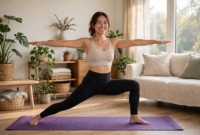

Strength training for beginners at home sounds like something that needs a gym membership, a rack of dumbbells and a trainer watching every rep. It does not. The truth is much simpler: your body weight, a small clear space on the floor and twenty minutes are enough to start. Strength training for beginners at home works because the first weeks are not about heavy weights at all. They are about teaching your muscles and your brain to work together, and your living room is a perfectly good classroom for that.
I have seen too many people wait months for the “right time” to get stronger. They wait until they can afford a gym, until work calms down, until they feel fit enough to start. That wait is the trap. Strength training for beginners at home removes every excuse at once, and this guide will show you exactly how to begin, which moves to learn first, and how to build a routine you will actually keep.
Table of Contents

What Is Strength Training for Beginners at Home?
Strength training for beginners at home means using resistance — your own body weight, bands, water bottles or light dumbbells — to make your muscles work harder than they do in everyday life. When a muscle works against resistance, tiny changes happen inside it. Over days and weeks, the muscle rebuilds itself a little stronger. That is the whole secret, and it works the same in a living room as it does in a gym.
You do not need to lift anything heavy to qualify. A slow squat to a chair, a push-up from your knees, a plank held for twenty seconds — all of these count. Strength training for beginners at home is built on simple moves done well, not on impressive weights. If the last few reps of a set feel hard but your form stays clean, you are doing it right.
There is one thing worth clearing up early. Strength training will not make a beginner bulky overnight. Building big muscles takes years of heavy lifting and very deliberate eating. What you will notice first is far more useful: stairs feel easier, shopping bags feel lighter, your posture improves, and your back complains less after a long day at a desk. Those are the real first results of strength training for beginners at home, and most people feel them within three to four weeks.
Why Strength Training Matters More Than You Think
Most of us think about exercise in terms of walking, running or cycling. Those are great for the heart, but they do not do much for your muscles. After the age of 30, adults lose roughly 3 to 8 percent of their muscle mass every decade if they do nothing about it. That slow loss is called sarcopenia, and it is why a flight of stairs feels harder at 50 than it did at 25. Strength training for beginners at home is the most direct way to push back against that loss.
The benefits go beyond muscle. Resistance training helps keep bones dense, which matters more as we age. It improves balance, so falls become less likely. It helps the body use blood sugar better, which is good news for anyone watching their weight or blood sugar levels. And there is a mood effect that surprises most beginners: a short strength session often leaves you feeling calmer and more awake than a cup of coffee does. The Centers for Disease Control and Prevention recommends muscle-strengthening activities on at least two days a week for adults, alongside regular aerobic activity, and that recommendation exists because the evidence behind it is strong.
Here is a number worth remembering. Research on beginners consistently shows that the biggest strength gains happen in the first eight to twelve weeks. A person who has never trained can often double their squat or push-up numbers in that window — not because they suddenly became an athlete, but because the nervous system learns the movements quickly. Strength training for beginners at home takes full advantage of that beginner window, and you do not need to pay anyone to access it.
What You Need to Start Strength Training for Beginners at Home
The honest answer is: almost nothing. Strength training for beginners at home starts with a clear space about the size of a yoga mat, a floor that is not slippery, and clothes you can move in. That is the whole required kit. Everything else is optional, and you should only buy it once you have trained for a few weeks and know you will keep going.
Still, a few cheap items make life easier. A yoga mat or a folded blanket protects your knees during floor work. A sturdy chair gives you something to hold for balance and a target for sit-to-stand squats. Two water bottles filled with sand weigh about a kilogram each and work as light dumbbells for arm exercises. If you want to spend a little money, a set of resistance bands costs roughly $10 to $30 and adds pulling exercises that are hard to do with body weight alone. Adjustable dumbbells are the next step, not the first one.
The room matters less than people think. A bedroom, a balcony, a corner of the living room — any space where you can stretch your arms out without hitting anything will do. Open a window if you can. Put your phone on silent. And keep a bottle of water nearby, because even a short session makes you thirsty. Strength training for beginners at home should feel easy to start, and a setup that takes five minutes to arrange is a setup you will skip. Keep it simple.
The 6 Moves Every Beginner Should Learn
You do not need fourteen exercises. You need six, done well. These six cover every major muscle group: legs, chest, back, glutes, shoulders and core. Learn them one at a time, practise them slowly, and only add weight or reps when the easy version feels too easy. This is the core of strength training for beginners at home, and if you master these six moves you have a complete workout for months.
1. Bodyweight Squat
Stand with your feet shoulder-width apart, toes pointing slightly out. Push your hips back like you are sitting into a chair, and lower yourself until your thighs are roughly parallel to the floor. Keep your chest up and your knees tracking over your toes, not collapsing inward. Push through your heels to stand back up. If a full squat feels too deep, squat to a chair instead: stand in front of it, sit down slowly, then stand up without using your hands. Start with 2 sets of 10 reps.
2. Knee Push-Up
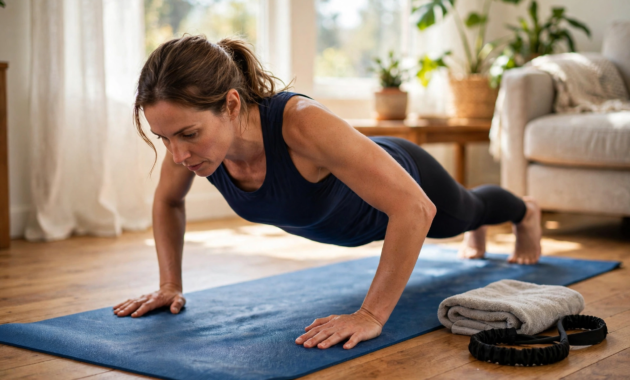
Place your hands on the floor slightly wider than your shoulders, knees on the ground, body in a straight line from head to knees. Lower your chest toward the floor by bending your elbows, keeping them at roughly a 45-degree angle to your body, then push back up. If knee push-ups feel easy after a few weeks, try one or two full push-ups at the start of each set and finish the rest on your knees. Start with 2 sets of 8 to 10 reps.
3. Glute Bridge
Lie on your back with knees bent and feet flat on the floor, hip-width apart. Squeeze your glutes and push your hips up until your body forms a straight line from shoulders to knees. Hold for two seconds at the top, then lower slowly. This move wakes up the glutes, which spend most of the day switched off while we sit. Weak glutes are one of the main reasons beginners get lower back pain, so this simple move earns its place. Start with 2 sets of 12 reps.
4. Bird Dog
Get on all fours, hands under shoulders and knees under hips. Slowly extend your right arm forward and your left leg back until both are straight, keeping your hips level. Hold for two seconds, return, and switch sides. This move trains the deep core muscles that keep your spine stable, and it is far kinder to beginners than sit-ups. Start with 2 sets of 8 reps per side.
5. Wall Row or Resistance Band Row
Pulling is the movement most home routines miss, and it matters because it balances all the pushing. If you have a resistance band, loop it around a sturdy door handle or a table leg, hold both ends, and pull your elbows back until your hands reach your ribs. Squeeze your shoulder blades together, then return slowly. No band? Use a sturdy table: lie underneath it, grip the edge, and pull your chest up to the table. Start with 2 sets of 10 reps.
6. Plank
Rest on your forearms and toes, body in one straight line from head to heels. Do not let your hips sag or pike up. Breathe normally — holding your breath is the most common beginner mistake here. If a full plank is too hard, drop to your knees. Hold for 20 seconds, rest, and repeat twice. Add five seconds each week and you will be amazed how fast a 60-second plank becomes normal.
A quick word on form. In strength training for beginners at home, slow beats fast every time. Lower yourself for three seconds, pause for one, and come back up in one or two. If a move hurts a joint — not the muscle working, but a sharp pain in a knee, shoulder or wrist — stop that move and try the easier version. Muscle burn is normal. Joint pain is a signal, not a badge of honour.
Your First 4-Week Plan for Strength Training for Beginners at Home
A plan turns good intentions into a habit. This one asks for three sessions a week, about 25 minutes each, with at least one rest day between sessions. Monday, Wednesday and Friday works well for most people. Strength training for beginners at home works best when the plan is small enough to repeat, so resist the urge to add extra exercises in week one.
| Week | Sessions | What changes |
|---|---|---|
| Week 1 | 3 sessions | Learn the 6 moves; 2 sets each; focus only on form |
| Week 2 | 3 sessions | Same 6 moves; 2 sets each; slow the lowering phase to 3 seconds |
| Week 3 | 3 sessions | Add a third set to squats and glute bridges; plank to 30 seconds |
| Week 4 | 3 sessions | 3 sets of every move; add light weight (water bottles or bands) to rows and squats |
A sample session looks like this. Warm up for five minutes: march in place, circle your shoulders, do ten slow bodyweight squats and ten arm swings. Then do the six moves in order, resting 60 to 90 seconds between sets. Finish with two minutes of gentle stretching — a standing quad stretch, a chest opener against a door frame, and a slow forward fold. That is the whole session. Write it on a piece of paper and tick off each workout; seeing four weeks of ticks is surprisingly motivating.
Rest days are part of the plan, not a failure of it. Muscles grow stronger while you recover, not while you train. If you train the same muscles hard two days in a row, you steal the recovery time they need. Two or three sessions a week is the sweet spot for strength training for beginners at home, and the CDC’s two-days-a-week guideline is a floor, not a ceiling — but start at the floor and earn the extra day.
How to Progress Without a Gym
After four to six weeks, bodyweight squats will start to feel easy. That is good news: it means you are stronger. The question is how to keep progressing without buying a gym’s worth of equipment. Strength training for beginners at home has four simple progression tools, and you only need one at a time.
First, add reps. If you can do 15 clean squats, you are ready for a harder version, not just more of the same. Second, slow down. A squat that takes five seconds to lower is far harder than one that takes one second, and it builds control. Third, change the leverage: move from knee push-ups to full push-ups, from a chair squat to a deep squat, from a knee plank to a full plank. Fourth, add load: a backpack with a few books, a gallon of water (about 8 pounds), or a resistance band all count as real weight.
A realistic timeline helps. Most beginners add a new challenge every two to three weeks. In three months, a typical beginner goes from knee push-ups to 10 full push-ups, from a 20-second plank to a 60-second plank, and from a chair squat to 15 deep goblet squats holding a water jug. None of that needs a gym. Strength training for beginners at home is a slow ladder, and the only rule is to climb one rung at a time. If you jump two rungs — doubling the weight and the reps in the same week — your joints will complain before your muscles do.
7 Mistakes That Slow Down Strength Training for Beginners at Home
Beginners do not fail because they lack willpower. They fail because of small mistakes that make training painful, boring or confusing. Here are the seven I see most often, and each one is easy to fix.
- Skipping the warm-up. Five minutes of marching, arm circles and easy squats raises your body temperature and wakes up the muscles. Cold muscles are stiff muscles, and stiff muscles get injured. Never skip it.
- Going too heavy too soon. The first week should feel almost too easy. That is correct. Your tendons and joints adapt slower than your muscles, and they need those easy weeks.
- Holding your breath. Breathing out on the hard part — pushing up from a squat, pressing up from a push-up — keeps your blood pressure steady and your form honest. If you catch yourself holding your breath, the set is too hard.
- Training every day. More is not better. Muscles need 48 hours between hard sessions on the same group. Three sessions a week beats six sessions a week for most beginners, because the six-session person quits in week three.
- Copying advanced workouts from social media. A video of someone doing pistol squats and muscle-ups is entertainment, not a beginner plan. Strength training for beginners at home should look boring. Boring works.
- Ignoring pain signals. Muscle soreness for a day or two after a new exercise is normal. Sharp pain in a joint, pain that lasts more than three days, or pain that gets worse during a set is not normal. Stop, rest, and see a doctor if it does not settle.
- Quitting after the first sore week. The soreness after your first two or three sessions is real — it has a name, delayed onset muscle soreness — and it fades fast. By week three, the same workout barely leaves you sore. Most people quit in the exact week the soreness was about to disappear.
Strength Training for Beginners at Home After 40
If you are starting after 40, or after 50, everything in this guide still applies — with two small adjustments. First, warm up a little longer: eight to ten minutes instead of five, with extra attention to ankles, hips and shoulders. Second, progress a little slower: stay on each step of the plan for three weeks instead of two. The payoff is bigger at this age, not smaller, because you are protecting bone density and balance at exactly the age when both start to slip.
One honest note. If you have heart disease, very high blood pressure, osteoporosis, a recent surgery, or any condition that limits movement, talk to your doctor before starting strength training for beginners at home. A short conversation costs nothing and it rules out the small number of cases where a particular exercise needs to be changed. Most people get a green light and a reminder to start light — which is the plan anyway.
If you already walk regularly, you have a head start. Walking keeps the habit muscle warm, and adding two short strength sessions a week to a walking routine is one of the simplest upgrades a busy adult can make. Our earlier guide to a home workout for beginners covers bodyweight routines that pair well with this one, and many readers use the two guides together — strength on Monday and Friday, a lighter home workout on Wednesday.

Frequently Asked Questions
How long before I see results from strength training for beginners at home?
Most people feel stronger within three to four weeks — stairs, shopping bags and getting up from a chair all get easier. Visible muscle changes take longer, usually eight to twelve weeks of steady training. The feeling comes first, the mirror catches up later, and that is normal.
Do I need dumbbells for strength training for beginners at home?
No. Body weight is enough for the first four to six weeks, and many people train with body weight alone for months. Dumbbells or resistance bands become useful when the easy versions of the six moves stop challenging you. When you do buy something, a set of resistance bands is the cheapest useful first purchase.
How many days a week should a beginner do strength training at home?
Two to three days a week, with at least one rest day between sessions. Three is the sweet spot for most people. The CDC recommends muscle-strengthening activities on two or more days per week, and that is a good minimum to build the habit around.
Can strength training for beginners at home help with weight loss?
Yes, but indirectly. Strength training builds muscle, and muscle burns more energy at rest than fat does. It also improves how the body handles blood sugar. The biggest weight-loss effect comes from combining strength sessions with walking and sensible eating — strength training alone is not a fast weight-loss tool, and anyone who promises that is selling something.
Is strength training safe for people with bad knees?
Often yes, with the right moves. Chair squats, glute bridges and step-ups are usually knee-friendly because you control the depth. Deep squats and jumping moves are the ones to avoid until your knees feel stronger. If a move causes sharp knee pain, stop it, try the easier version, and ask a doctor or physiotherapist if the pain keeps coming back.
Disclaimer
The content in this article is general educational information only. It is not medical, professional or financial advice. Exercise carries some risk, and individual needs vary — if you have a health condition, an injury, or any doubt about whether an exercise is safe for you, check with a qualified health professional before starting. Details such as prices, guidelines and product availability change over time, so please verify from official sources before acting on them.
To learn more about the site behind this guide, visit the About Us page.