

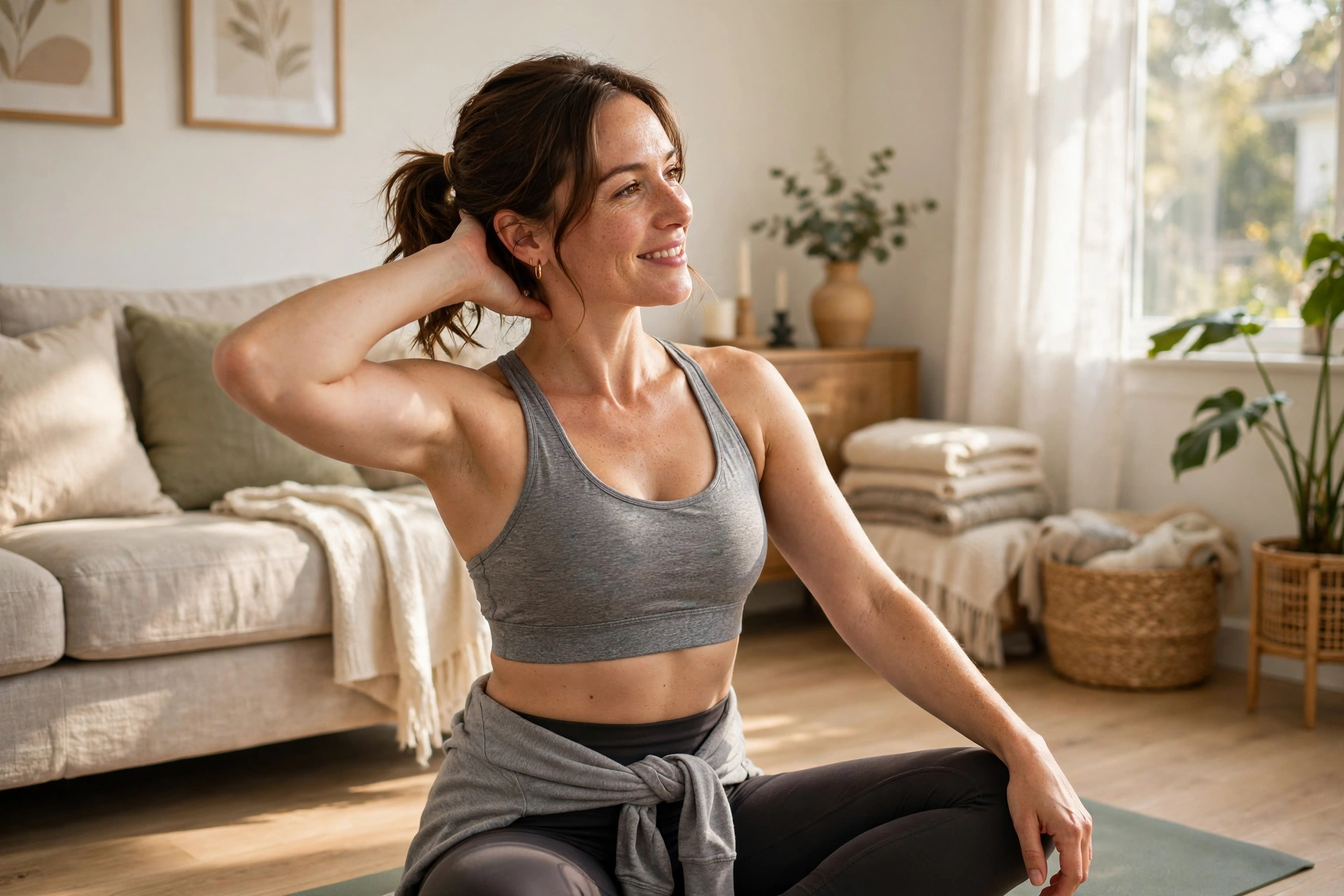
I could not touch my toes when I first tried stretching exercises for beginners. Not even close. My fingertips stopped about six inches short, my hamstrings complained loudly, and I decided on the spot that stretching was something other people did — flexible people, yoga people, not me.
That was a mistake. Two years later, ten quiet minutes of stretching exercises for beginners most mornings has done more for my stiff shoulders and aching lower back than any expensive gadget I ever bought. I still cannot fold myself in half, and that is fine. Stretching is not about becoming a gymnast. It is about moving a little better, hurting a little less, and keeping your body usable for the life you actually live.
If your neck hurts after a long day at a desk, if your legs feel tight after a walk, or if you simply want to move more freely as you get older, stretching exercises for beginners are the easiest place to start. No equipment, no gym, no special skill. Just you, a bit of floor space, and ten minutes.
Table of Contents

What Are Stretching Exercises for Beginners?
Stretching exercises for beginners are simple, gentle movements that lengthen a muscle and move a joint through its comfortable range. You hold a position, breathe normally, and let the muscle relax into the stretch. Nothing is forced. Nothing should hurt.
A good beginner routine covers the areas that tighten up first in most people: the neck, the shoulders, the chest, the hips, the hamstrings, and the calves. That is about seven areas, and you can work through all of them in roughly ten minutes. Each stretch is held for 20 to 30 seconds, and you repeat it on both sides where it applies. The best stretching exercises for beginners keep things this simple on purpose: a short list, clear instructions, and nothing that needs a manual to follow.
There are two main types you will meet, and knowing the difference keeps you safe.
Static vs Dynamic Stretching: Know the Difference
| Type | What it is | When to use it |
|---|---|---|
| Static stretching | Holding one position for 20–60 seconds | After a workout, or once muscles are warm |
| Dynamic stretching | Gentle, controlled movement through a range | Before a workout, as a warm-up |
| Ballistic stretching | Bouncing at the end of a stretch | Avoid it — it can strain muscles |
Static stretching is the heart of most stretching exercises for beginners, and it is the type this guide focuses on. You move into a stretch slowly, hold it, and breathe. Dynamic stretching — arm circles, leg swings, gentle twists — works better as a warm-up because it raises your temperature and wakes the muscles up without holding them cold and still.
One rule covers both: never bounce. Bouncing pushes a muscle past the point it is ready for, and that is how small strains happen. Slow and steady wins here, every single time.
Why Stretching Exercises for Beginners Actually Work
Stretching gets dismissed as the boring part of fitness, the bit people skip. That is a shame, because the benefits show up fast and they are hard to argue with.
First, flexibility. Most adults lose a little range of motion every year they do not stretch. Shoulders creep forward, hips tighten from sitting, hamstrings shorten. A few minutes of stretching exercises for beginners, done two or three times a week, slows that slide down and can even reverse some of it. The Mayo Clinic recommends stretching major muscle groups at least two to three days a week, and their guidance is a solid starting point for anyone unsure where to begin — see the Mayo Clinic’s guide to basic stretches for the same advice from doctors.
Second, everyday comfort. A stiff neck after eight hours at a laptop is not a mystery; it is a muscle held in one position for too long. Gentle stretching breaks that pattern. Many people I know who started a short daily routine say the same thing within two weeks: their shoulders sit lower, their lower back complains less, and turning their head to reverse the car stops feeling like a chore.
Third, injury prevention. Warm, flexible muscles handle sudden movements better than cold, tight ones. Stretching will not make you invincible, but it lowers the odds of the small pulls and strains that come from everyday life — lifting a suitcase, chasing a child, slipping on a wet step.
Fourth, stress. This one surprised me. Slow stretching with steady breathing calms your nervous system in a way that feels a lot like meditation, except you are moving. Ten minutes in the morning can set a calmer tone for the whole day, and a short stretch before bed helps many people sleep better.
The 7 Rules of Safe Stretching
Before your first session, these seven rules matter more than any single stretch. Tape them to your wall if it helps. Every set of stretching exercises for beginners should follow them, because the rules are what keep a gentle habit from turning into a sore muscle.
1. Warm up first
Cold muscles do not like being stretched. Walk around the house for five minutes, march in place, or do a few arm circles first. Stretching exercises for beginners work best when your body temperature is already slightly up.
2. Never bounce
I said it above and I will say it again: no bouncing. Move into each stretch slowly, hold it still, and breathe. Bouncing is the fastest way to turn a good habit into a pulled muscle.
3. Hold for 20 to 30 seconds
Short holds of five seconds do almost nothing. Aim for 20 to 30 seconds per stretch, breathing normally the whole time. If you are comfortable, you can build up to 60 seconds over a few weeks.
4. Feel a gentle pull, not pain
A stretch should feel like a mild tension, maybe a 3 or 4 out of 10. Sharp pain, numbness, or tingling means stop at once. Pain is information, not a badge of honour.
5. Breathe normally
Holding your breath tenses the very muscles you are trying to relax. Slow, easy breaths. In through the nose, out through the mouth, and let the exhale help you ease a fraction deeper.
6. Stretch both sides
Your body is not symmetrical in its tightness, but both sides still need the work. Do every one-sided stretch on the left and the right, even if one side feels easier.
7. Be consistent, not heroic
Two or three short sessions a week beat one brutal hour every Sunday. Stretching exercises for beginners reward regularity above all else. Five minutes a day, most days, will change how you feel within a month.
A 10-Minute Stretching Routine for Beginners
Here is the routine I would give a friend who has never stretched before. It takes about ten minutes, needs no equipment, and covers the whole body from neck to calves. Do it after a short warm-up, or after a walk. These stretching exercises for beginners are deliberately gentle, so you can repeat the full routine every day if you like.
1. Neck stretch — 30 seconds each side
Sit or stand tall. Let your right ear drift toward your right shoulder until you feel a gentle pull down the left side of your neck. Hold for 30 seconds, breathing slowly, then switch sides. Keep your shoulders down and relaxed; do not lift them toward your ears.
2. Shoulder stretch — 30 seconds each side
Bring your right arm across your chest and hold it gently with your left hand, just above the elbow. You should feel the stretch across the back of the shoulder. Hold for 30 seconds, then switch arms. This one is gold for anyone who types all day.
3. Chest stretch — 30 seconds
Stand in a doorway, place your forearms on the frame at shoulder height, and step gently forward until you feel your chest open. Hold for 30 seconds. If you have no doorway handy, clasp your hands behind your back and lift them slightly while opening your chest.
4. Cat-cow stretch — 8 slow repetitions
On hands and knees, breathe in as you let your belly drop and your head lift (cow), then breathe out as you round your spine toward the ceiling (cat). Move slowly. Eight repetitions wake up the whole spine and feel wonderful after a long day of sitting.
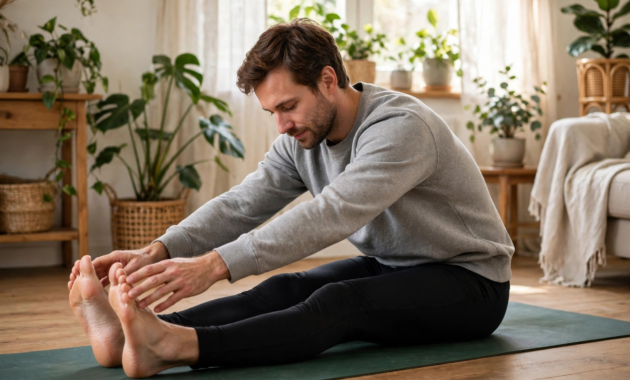
5. Seated hamstring stretch — 30 seconds each leg
Sit on the floor with one leg straight and the other bent, foot against the inner thigh. Reach gently toward the toes of the straight leg — only as far as comfortable — and hold for 30 seconds. Switch legs. A slight bend in the knee is fine if your hamstrings are very tight.
6. Standing quad stretch — 30 seconds each leg
Stand near a wall or chair for balance. Bend one knee, bring the heel toward your glute, and hold your ankle with the same-side hand. Keep your knees close together and your standing leg soft. Hold for 30 seconds, then switch. This is one of the simplest stretching exercises for beginners, and it loosens the front of the thigh that tightens from sitting all day.
7. Calf stretch — 30 seconds each leg
Face a wall, place both hands on it, and step one foot back with the heel pressed into the floor. Lean gently forward until you feel the calf stretch. Hold for 30 seconds, then switch. Tight calves are behind more ankle and knee complaints than most people realise.
8. Seated twist — 30 seconds each side
Sit tall with both legs extended, cross your right foot over your left knee, and twist gently to the right, looking over your right shoulder. Hold for 30 seconds, then switch. Keep the twist slow and comfortable; your spine will thank you.
That is the whole routine. Eight stretches, ten minutes, done. If you only have five minutes, pick four of them and rotate which ones you skip each day.
How Often Should You Stretch?
For most people, two to three sessions a week is enough to feel a real difference, and that matches the guidance from health authorities. Daily gentle stretching is also fine, as long as every session stays comfortable and pain-free. The best frequency is the one you will actually keep, and that is the real secret of stretching exercises for beginners: a modest routine you repeat beats a perfect routine you abandon.
A simple way to start: attach stretching to something you already do. Stretch for five minutes after your morning tea, or for ten minutes while the evening news is on. Habits stick when they ride on top of routines that already exist.
If you already exercise, stretching slots in neatly around it. Do dynamic movements before a workout and static stretches afterwards, when the muscles are warm. If you follow a home workout for beginners, a five-minute stretch at the end turns a good session into a complete one.
7 Mistakes Beginners Make (and How to Avoid Them)
Most of these are easy to fix once you know them. Here are the seven that trip up stretching exercises for beginners most often.
Mistake 1: Stretching cold muscles
Jumping straight into deep stretches first thing in the morning, before moving at all, is asking for a strain. Warm up for five minutes first.
Mistake 2: Holding your breath
Beginners almost always hold their breath without noticing. If you catch yourself doing it, exhale slowly and let the stretch soften.
Mistake 3: Comparing yourself to others
The person next to you in a class may touch their palms to the floor. That is their body, their history. Your only comparison is yourself last week. Progress in stretching exercises for beginners is measured in small, steady gains, not in dramatic poses.
Mistake 4: Skipping one side
It is tempting to stretch only the side that feels tight. Do both sides anyway. Imbalances grow quietly, and even stretching helps keep them in check.
Mistake 5: Rushing through the routine
Five seconds per stretch is a warm-up for the stretch itself, not the stretch. Give each hold its full 20 to 30 seconds, or the routine does little.
Mistake 6: Stretching through pain
Pain is a stop sign, not a challenge. If a stretch hurts, ease off or skip it. If pain keeps returning, check with a doctor or physical therapist before continuing.
Mistake 7: Quitting after one week
Flexibility changes slowly. The first two weeks feel like nothing is happening, and then one morning you realise you can reach the top shelf without a wobble. Give it at least four weeks before judging it.
Stretching for Desk Workers: A 5-Minute Fix
If you sit at a desk all day, you do not need a full routine at work — you need a short reset you will actually do. Every two hours, stand up and run through these four moves. The whole thing takes five minutes, and it works as a lighter version of the stretching exercises for beginners routine above.
- Neck stretch, 30 seconds each side.
- Shoulder rolls, ten slow circles forward and ten back.
- Chest stretch in the doorway, 30 seconds.
- Standing hamstring stretch, one foot on a low step or chair, 30 seconds each leg.
Set a quiet alarm if you have to. Your future self — the one without the 4 p.m. headache — will be grateful. These four moves are the simplest stretching exercises for beginners who sit all day, and they take less time than making a cup of tea.
When to Check With a Doctor First
Stretching is safe for most healthy adults, but a few situations call for professional advice first. Check with a doctor or physical therapist before starting if you have had a recent injury or surgery, a joint or spine condition, osteoporosis, or any condition that affects your balance. The same applies if a stretch causes numbness, tingling, or pain that lasts more than a day or two. Even then, stretching exercises for beginners are usually still possible — you may simply need a shorter or gentler version.
This is not a reason to avoid stretching. It is a reason to get the right version of it for your body, which is exactly what a physical therapist is for.

Frequently Asked Questions
How long does it take to see results from stretching exercises for beginners?
Most people notice small changes within two to three weeks of stretching two or three times a week — reaching a little further, feeling less stiff in the morning. Bigger flexibility gains usually take six to eight weeks of steady practice, which is normal for stretching exercises for beginners.
Is it better to stretch in the morning or at night?
Both work. Morning stretching loosens overnight stiffness and wakes the body up; evening stretching helps you unwind and can improve sleep. Pick the time you will stick with, and stay consistent.
Can stretching exercises for beginners help back pain?
Gentle stretching can ease mild, muscle-related back pain, especially the stiffness that comes from sitting. Many stretching exercises for beginners include the cat-cow and seated twist precisely because they help the lower back. It is not a treatment for serious back problems, though. If your back pain is severe, sudden, or comes with numbness or weakness, see a doctor first.
Do I need any equipment to start stretching?
No. A mat or a carpeted floor is nice, and a chair or wall helps with balance, but stretching exercises for beginners need nothing you do not already have at home. That is part of their appeal: the only equipment is a small patch of floor.
How many days a week should a beginner stretch?
Two to three days a week is the recommended minimum for real progress, and daily gentle stretching is fine too. Start with three short sessions a week, then add more only if you enjoy it. That is the whole plan for stretching exercises for beginners: start small, stay regular, and let the results build.
Disclaimer
This article is general educational information about stretching and flexibility. It is not medical advice, and it does not replace guidance from a doctor, physical therapist, or other qualified health professional. Details such as recommendations, guidelines, and health advice can change over time, so please verify important information from official sources before acting on it. If you have a health condition, injury, or any concern about exercise, consult a professional first.
To learn more about the site behind this guide, visit the About Us page.