
I still remember my first attempt at yoga for beginners at home. I rolled out a mat in the middle of my living room, pressed play on a video, and spent the first five minutes just trying to figure out which way the mat was supposed to face. Ten minutes later I was lying flat on my back, breathing slowly, and wondering why I had waited so long to try it. That first session taught me more than any article could: yoga for beginners at home is less about the poses and more about showing up.
That is the honest truth about starting yoga at home. It looks calm and graceful from the outside, and a little intimidating too. But the first session is not about touching your toes or holding a perfect pose. It is about giving yourself fifteen quiet minutes and learning to move slowly. That slow, unhurried feeling is the heart of yoga for beginners at home.
This guide walks you through yoga for beginners at home from the very first step: what yoga actually is, what you need (almost nothing), which styles suit a first-timer, eight easy poses, a simple fifteen-minute routine, and the mistakes worth skipping. No flexibility required. No studio membership. Just a small patch of floor and a willingness to begin.
Table of Contents
What Yoga for Beginners at Home Really Means
Yoga is a practice that brings three things together: physical postures, breathing, and a settled kind of attention. The postures are called asanas. The breathing is called pranayama. And the attention part is simply noticing what your body is doing instead of rushing through it.
Yoga for beginners at home means doing all of that in your own space, at your own pace, without an audience. You follow a short routine or a beginner video, you move slowly, and you stop whenever something hurts. That is the whole secret. There is no test at the end and nobody is grading your balance. You set the pace, you choose the poses, and you decide when to rest — that freedom is what makes yoga for beginners at home so welcoming.
Most beginners picture yoga as people folded into impossible shapes. Real beginner yoga looks very different. It looks like standing tall and breathing. It looks like moving your spine gently on hands and knees. It looks like lying still for two minutes at the end and letting your shoulders drop. If you can do those three things, you can do yoga for beginners at home.
One more thing worth saying plainly: flexibility is not the entry fee. Flexibility is one of the things a regular practice slowly gives you. You do not need it before you start, and anyone who tells you otherwise is selling something.
Why Yoga for Beginners at Home Works So Well
Home practice has three advantages a studio cannot match, and they matter most in the first month.
First, it is free. A studio class can cost anywhere from 10 to 25 dollars a session, and that adds up fast when you are still deciding whether yoga is for you. Yoga for beginners at home costs nothing to try. A folded blanket works as a mat for the first two weeks. That zero-cost start is one of the best things about yoga for beginners at home.
Second, it is private. Nobody watches you wobble in tree pose. Nobody sees you fall out of a balance and laugh. That privacy is a gift when you are learning, because it removes the one thing that stops most beginners: embarrassment.
Third, it fits your life instead of the other way round. Ten minutes before breakfast. Fifteen minutes after the kids are in bed. A short session on a lunch break. When practice takes ten minutes and zero travel, you actually do it — and doing it regularly is the entire game. That is the quiet advantage of yoga for beginners at home: the mat is always there, so the habit forms faster than any gym routine I have tried.
Research backs up the habit side of this. A survey of more than 1,000 yoga practitioners found that how often people practised at home predicted their health better than how many years they had been practising. Frequency beats experience. Short and often wins.
What You Need to Start Yoga for Beginners at Home
The honest answer is: almost nothing. Here is the short list, in order of importance.
A Small Patch of Floor
You need enough space to stretch your arms wide and take one full step in any direction. A space about six feet by four feet is plenty. Push a coffee table aside, roll up a rug, and you are set. A quiet corner beats a big room — fewer distractions, easier to focus.
A Mat (or a Towel for Now)
A yoga mat gives you grip and a little cushioning for your knees. A basic one costs very little and lasts for years. But do not let the lack of a mat delay your first session. A folded blanket, a large towel, or even a carpeted floor will do for the first fortnight. Buy the mat once you know you will keep going. Everything else on this list is optional, and that is the point — yoga for beginners at home should cost you almost nothing to start.
Clothes You Can Move In
Loose, comfortable clothes you can bend and stretch in are enough. Most people practise in bare feet, which helps you grip the mat and feel your balance. Skip the special outfits until you know what you like.
A Few Cheap Props That Help
Two props make beginner yoga noticeably easier, and both cost almost nothing. A firm cushion or folded blanket lifts your hips in seated poses, which takes pressure off your lower back. A sturdy chair or a wall gives you something to hold when a balance pose feels wobbly. A hardback book works as a yoga block. You do not need to buy a single prop to start yoga for beginners at home — look around your house first.
Which Yoga Style Is Best for Beginners at Home
The word yoga covers a wide spread, and some styles are far kinder to a first-timer than others. Pick one of these four and you will be fine. Each one works well for yoga for beginners at home, so choose the one that sounds most inviting and start there.
Hatha Yoga
Hatha moves at a slower pace and holds each posture a little longer, which gives you time to find the shape before the next one arrives. Health experts often rate it as the best starting point for exactly that reason. If a video or class is labelled Hatha, gentle, slow flow, or beginners, you are in the right place.
Gentle and Slow Flow
Slow flow links a few poses together with the breath, but at half the speed of a regular flow class. It is a good second step once Hatha feels comfortable, usually after two or three weeks.
Yin Yoga
Yin holds passive floor poses for two to five minutes each. It is quiet, slow, and excellent for stiff hips and tight hamstrings. It suits people who want yoga to feel more like stretching than exercise.
Restorative Yoga
Restorative uses bolsters and blankets to support your body in restful poses. It is the gentlest style there is, and a good choice if you are coming back from illness, injury, or a long break from exercise.
Styles to Skip for Now
Steer clear of hot yoga, power yoga, and fast vinyasa at the start. They assume you already know the postures and can move between them quickly, which is a lot to take on while you are still learning what your body does. You can try them later. The first month belongs to the slow styles. Give yourself that slow month. Yoga for beginners at home is a long game, and the slow styles build the foundation everything else rests on.
8 Easy Poses for Yoga for Beginners at Home
These eight poses cover the whole body: standing, balance, spine, hips, and rest. Learn them one at a time, hold each for five to eight slow breaths, and never force a stretch. If you cannot breathe evenly inside a pose, come out of it a little. That is the rule that keeps you safe. Work through them in order the first few times — that order is a gentle full-body sequence, and it is how most people learn yoga for beginners at home.
1. Mountain Pose (Tadasana)
Stand tall with your feet hip-width apart, arms relaxed at your sides, weight even across both feet. Lift the top of your head toward the ceiling and let your shoulders drop away from your ears. Breathe slowly. It looks simple, and it is — but standing well is the foundation of every other pose, and most of us have forgotten how to do it.
2. Cat-Cow (Marjaryasana-Bitilasana)
Come onto hands and knees, wrists under shoulders, knees under hips. On an inhale, let your belly drop and lift your head and tailbone. On an exhale, round your spine toward the ceiling and tuck your chin. Move slowly, one breath per movement, for five rounds. This is the single best warm-up for a stiff spine, and it takes less than a minute.
3. Child’s Pose (Balasana)
From hands and knees, sit your hips back toward your heels and stretch your arms forward, forehead resting on the mat. This is your rest pose. Come here whenever you need a break, in any routine, at any time. Staying here for a minute and breathing slowly counts as yoga. It really does.
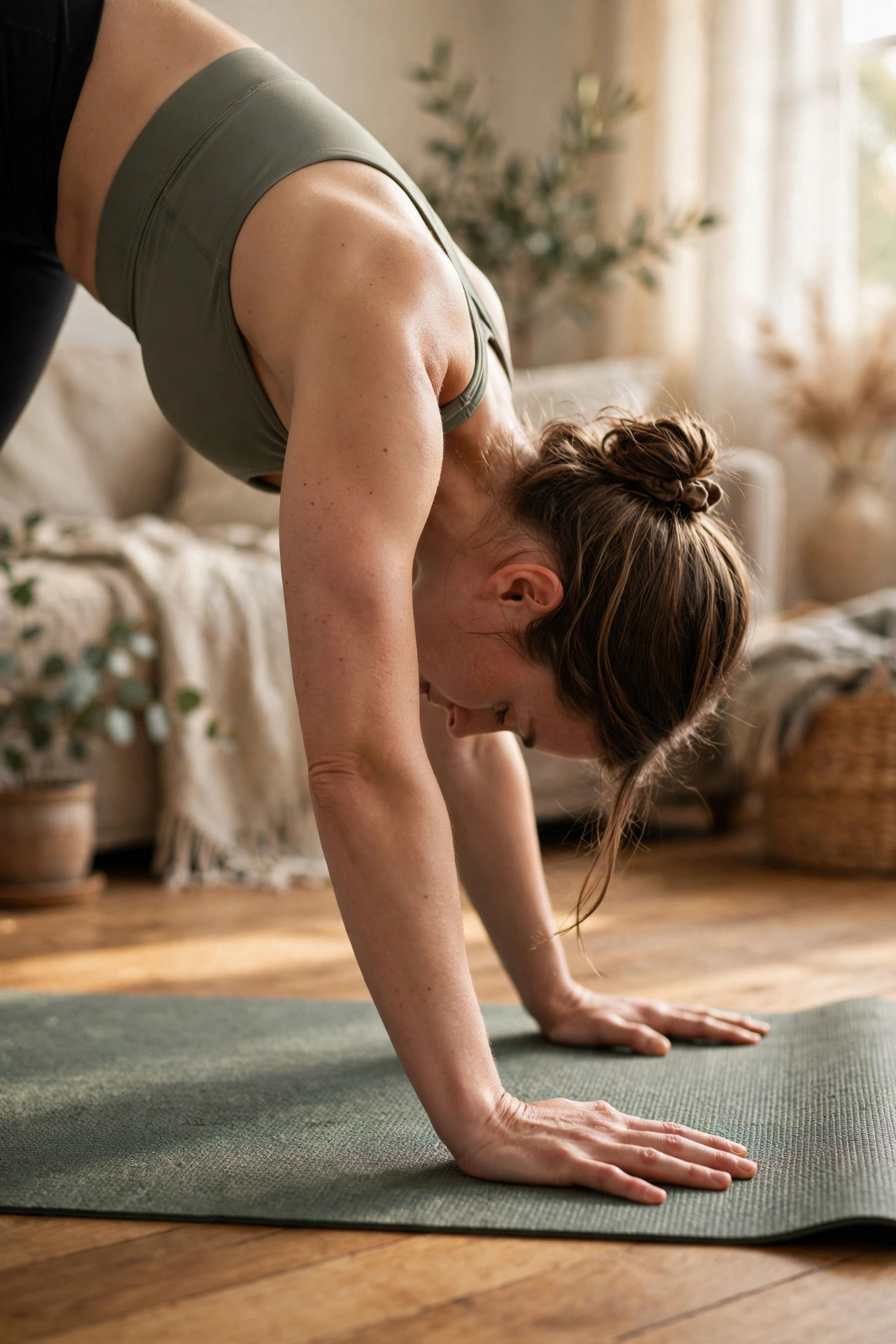
4. Downward Facing Dog (Adho Mukha Svanasana)
From hands and knees, tuck your toes and lift your hips up and back, making an upside-down V shape. Keep your knees softly bent if your hamstrings are tight — straight legs are not the goal. Pedal your feet gently, one heel down at a time. Hold for five breaths, then rest in child’s pose.
5. Low Lunge (Anjaneyasana)
Step your right foot forward between your hands, left knee on the mat, and lift your arms overhead. Keep your front knee over your ankle, not past your toes. This opens the hip flexors, which spend all day shortened by sitting. Hold five breaths, then switch sides.
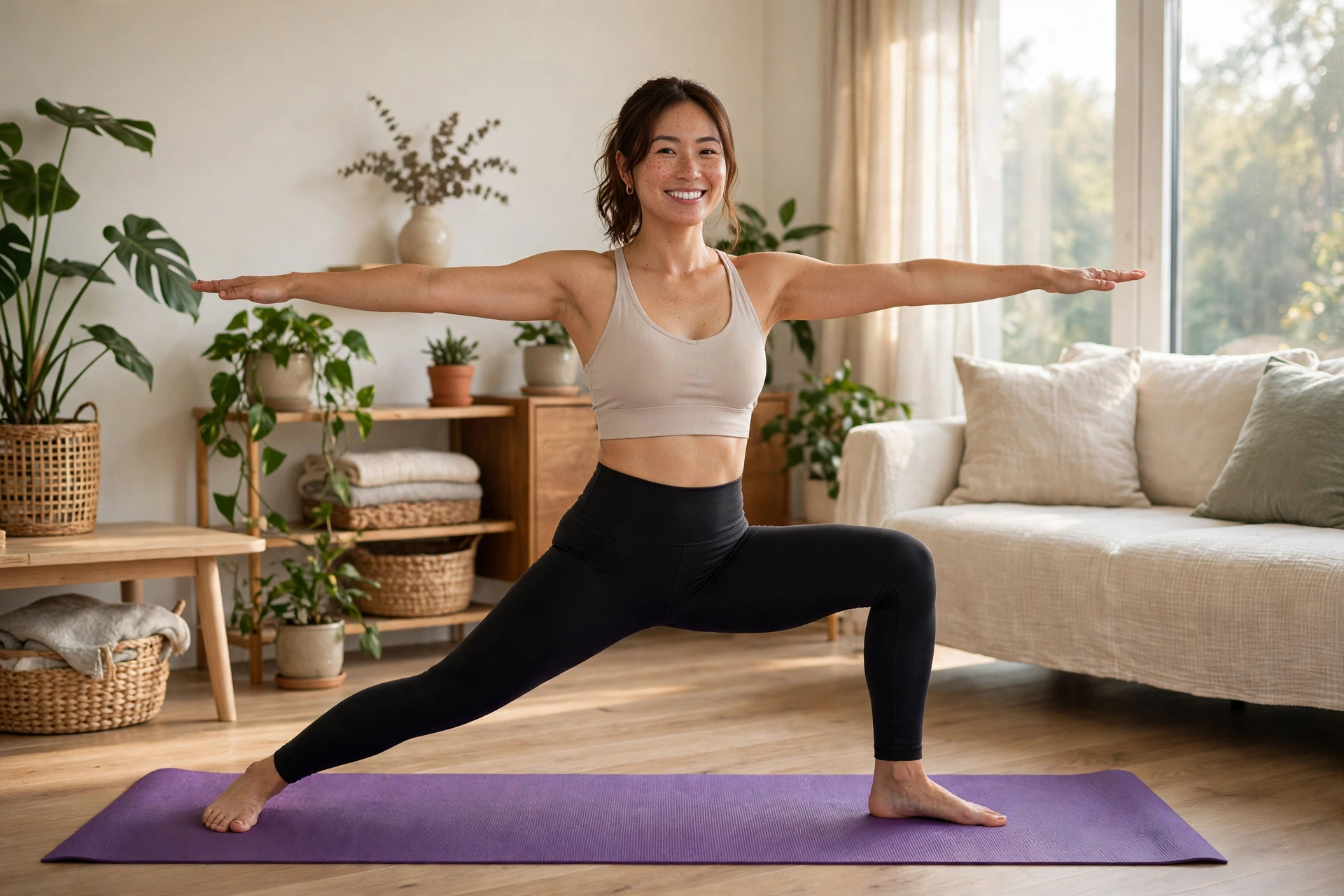
6. Warrior II (Virabhadrasana II)
Stand with your feet wide apart, turn your right foot out, and bend your right knee over your ankle. Stretch your arms out to the sides at shoulder height and look over your right hand. Strong legs, open chest, steady gaze. Hold five breaths, then switch sides. This is the pose that makes beginners feel like they are actually doing yoga.
7. Tree Pose (Vrksasana)
Stand on one leg and place the sole of your other foot on your ankle or calf — never on the knee joint. Press your palms together at your chest and pick one spot on the floor to look at. Wobble. Everybody wobbles. Use a wall or a chair until your balance improves. Hold five breaths each side.
8. Bridge Pose (Setu Bandha Sarvangasana)
Lie on your back, knees bent, feet flat on the floor near your hips. Press through your feet and lift your hips toward the ceiling, keeping your shoulders on the mat. Hold for five breaths, then lower slowly. This strengthens the glutes and the back of the legs, and it feels wonderful after a day of sitting.

A Simple 15-Minute Routine for Yoga for Beginners at Home
Here is the routine I give to friends who ask where to start. It uses the poses above, takes fifteen minutes, and needs no equipment beyond a mat or a blanket. Do it two or three times a week and you will feel the difference within a month. If you only remember one thing from this guide, remember this: yoga for beginners at home works because it is short, simple, and repeatable.
| Step | What to do | Time |
|---|---|---|
| 1 | Mountain pose, slow breathing | 1 minute |
| 2 | Cat-cow, five slow rounds | 2 minutes |
| 3 | Downward facing dog | 1 minute |
| 4 | Low lunge, right side | 1 minute |
| 5 | Low lunge, left side | 1 minute |
| 6 | Warrior II, right side | 1 minute |
| 7 | Warrior II, left side | 1 minute |
| 8 | Tree pose, right side | 1 minute |
| 9 | Tree pose, left side | 1 minute |
| 10 | Bridge pose, two rounds | 2 minutes |
| 11 | Child’s pose, rest and breathe | 2 minutes |
| 12 | Lying flat, eyes closed, do nothing | 1 minute |
Two practical notes. First, practise on an empty stomach or a light one — a full meal and forward folds do not mix. Second, if fifteen minutes feels long on day one, do the first six steps only. A short practice you finish beats a long one you abandon. Build the habit first and the length later — that is the whole method behind yoga for beginners at home.
How Often Should You Practise Yoga for Beginners at Home?
Two or three sessions a week is plenty to start. That small commitment is enough — yoga for beginners at home is built on short sessions, not heroic ones. Fifteen minutes each. That is 30 to 45 minutes a week, which is less time than most people spend scrolling their phones before bed.
After a month, most people naturally want more. Four or five short sessions a week is a good next step. Daily practice is fine too, as long as you keep it gentle — ten minutes every day beats ninety minutes once a week, and the research on home practice agrees. That is why the schedule for yoga for beginners at home is so forgiving: even a missed day costs you nothing if you come back tomorrow.
The real enemy is not laziness. It is the all-or-nothing trap. People miss one session, feel guilty, and quit for a month. The fix is a simple rule: never miss twice. Miss a day, fine. Practise the next day, even if it is only four minutes of cat-cow and child’s pose. Four minutes keeps the habit alive, and the habit is the whole point.
7 Mistakes to Avoid in Yoga for Beginners at Home
These are the mistakes I see most often, and I made at least four of them myself. Avoid these seven and your first month of yoga for beginners at home will go far more smoothly than mine did.
1. Forcing a Stretch
Pain is not progress. A gentle stretch is fine; a sharp pain is your body saying stop. Back off until you can breathe easily again. Flexibility comes from patience, not force.
2. Holding Your Breath
Beginners hold their breath without noticing, especially in hard poses. If you catch yourself doing it, come out of the pose, breathe, and try again a little smaller. The breath is the practice — the shape is secondary.
3. Copying the Person on the Screen
The teacher in the video has practised for years. Their hamstrings are not your hamstrings. Bend your knees in downward dog. Use blocks. Take the easier version. Yoga for beginners at home works when you practise your version of the pose, not theirs.
4. Skipping the Warm-Up
Jumping straight into deep stretches with cold muscles is how strains happen. Two minutes of cat-cow and gentle movement first. Always.
5. Trying Advanced Poses Too Soon
Headstands, shoulder stands, full wheel, and forceful breathing exercises are not beginner poses. Health authorities advise beginners to avoid them without supervision. There is plenty to learn in the eight poses above before you ever need an inversion. Keep your first months of yoga for beginners at home simple, and the advanced poses will still be there when you are ready.
6. Practising on a Full Stomach
Wait at least two hours after a big meal, or one hour after a light snack. Your body will thank you, especially in twists and forward folds.
7. Quitting in Week Three
Most people stop in weeks three to five, not week one. The novelty wears off and the habit has not formed yet. Plan for it. Put your mat where you can see it. Practise at the same time each day. And remember the four-minute rule: on a bad day, four minutes still counts.
Staying Safe: When to Slow Down or Ask a Doctor
Yoga is generally safe for healthy people when practised sensibly, and research links a regular practice to better flexibility, balance, and lower stress. But a few situations call for care.
If you are pregnant, recovering from surgery or an injury, have balance problems, uncontrolled high blood pressure, glaucoma, or osteoporosis, talk to your doctor before starting, and tell any teacher about it. The same applies if you have a joint replacement or a current injury. A doctor can tell you which movements are appropriate and which to skip.
Stop immediately and seek help if you develop sharp pain, severe dizziness, fainting, chest pain, new numbness or weakness, or difficulty breathing. These are rare, but they are not things to push through.
For everyone else, the safety rules are simple: move slowly, never force a stretch, use a wall or chair for balance, and come out of any pose you cannot breathe evenly inside. These rules matter even more when you practise yoga for beginners at home without a teacher in the room, so take them seriously. The National Center for Complementary and Integrative Health has a clear, plain-English guide to yoga safety that is worth reading before your first session — I have linked it below.
How to Stay Consistent with Yoga for Beginners at Home
Starting is easy. Continuing is the hard part. Here is what actually works, based on what has worked for me and for the friends I have dragged onto a mat.
Keep your mat visible. A mat rolled up in a cupboard is a mat you forget. A mat unrolled in the corner of your living room is an invitation. Leave it out. A visible mat is a daily reminder, and that reminder is half the battle in yoga for beginners at home.
Practise at the same time every day. Morning works best for most people because the day has not had a chance to get in the way yet. Ten minutes before breakfast, same time, same place. After two weeks it stops feeling like a decision.
Track it simply. A tick on a calendar for every day you practise. Watching the chain of ticks grow is surprisingly motivating, and breaking the chain hurts just enough to keep you going.
Use a good beginner video series. Free beginner videos have made good instruction genuinely accessible, and a familiar teacher’s voice makes the routine feel easier. Pick one series and follow it for a month instead of jumping between videos every day. Sticking with one teacher for a month is one of the simplest ways to make yoga for beginners at home feel like a routine instead of a chore.
Get one class of correction within three months. A screen cannot see when your shoulders are creeping up toward your ears, and a real person can. One or two in-person classes early on will correct habits that are much harder to fix later. Community centres and local studios often run affordable beginner sessions.
Frequently Asked Questions
Can you really learn yoga at home by yourself?
Yes, for the basics. Standing postures, gentle floor movements, simple breathing, and relaxation are all safe to learn on your own from a good beginner video or guide. What you should not teach yourself is headstands, shoulder stands, deep backbends, and forceful breathing exercises. For those, get a teacher. And as noted above, one in-person class within your first three months is a smart investment. That combination — home practice plus one real class — is how most people learn yoga for beginners at home successfully.
Do I need to be flexible to start yoga for beginners at home?
No. This is the biggest myth in yoga. Flexibility is a result of practising, not a requirement for starting. If you cannot touch your toes, you are exactly the person yoga is for. Start with bent knees, use props, and let your range improve over weeks and months.
How long should a beginner yoga session last?
Ten to fifteen minutes is ideal for the first month. That is long enough to warm up, practise six to eight poses, and rest at the end — and short enough that you will actually do it. Longer sessions come naturally later, once the habit is in place.
What is the best time of day to do yoga at home?
Morning is the most popular choice because it sets a calm tone for the day and is the easiest slot to protect. But the best time is the time you will actually do it. Some people prefer an evening session to unwind. Pick one slot, keep it consistent, and do not argue with yourself about it every day.
Is yoga for beginners at home enough exercise on its own?
Yoga builds flexibility, balance, and body awareness, and gentle styles build some strength too. But it is not a complete exercise programme by itself. Pair it with walking or another activity you enjoy — for example, the home workout routine on this site — and you cover strength, stamina, and mobility together. That combination is hard to beat.
Disclaimer
This article is general educational information only. It is not medical advice, a diagnosis, or a treatment plan, and it is not a substitute for professional guidance from a doctor or a qualified yoga teacher. Details such as prices, rules, and offers change over time, so please verify anything important from official sources before acting on it. If you have a health condition, an injury, or you are pregnant, talk to your doctor before starting a new exercise routine.
To learn more about the site behind this guide, visit the About Us page.