
If you have ever watched a Pilates class and thought it looked easy, your first session will probably change your mind. The moves are slow. Nothing looks dramatic. Then your deep stomach muscles start shaking after about thirty seconds, and you realise this quiet workout is doing real work. That surprise is exactly why pilates for beginners has become so popular with people who want to get stronger without jumping, running, or lifting heavy weights.
I like Pilates for one simple reason: it rewards control, not speed. You do fewer repetitions, you breathe on purpose, and you pay attention to how each movement feels. For a complete beginner, that is a friendly way to start. This guide explains what Pilates is, what you need, seven starter exercises, and a weekly plan that will not leave you sore for a week.
Table of Contents
What Pilates Actually Is
Pilates is a low-impact exercise method created by Joseph Pilates in the early twentieth century. He called it Contrology, and the name still fits. Every exercise asks you to move from a stable centre, which means your deep abdominal muscles, your pelvic floor, and the small muscles along your spine do the main work while your arms and legs move around them.
A typical pilates for beginners session mixes lying, seated, side-lying, and standing movements. Most are done slowly, with specific breathing, for about 5 to 10 repetitions each. It looks calm from the outside. Inside, your muscles are working hard to keep your body steady.
Pilates is not the same as yoga, even though both use a mat and pay attention to breathing. Yoga usually holds poses longer and includes a strong flexibility and relaxation side. Pilates keeps moving through small, controlled repetitions with a bigger focus on core strength and posture. If you enjoy slow, floor-based exercise, our guide to yoga for beginners at home pairs nicely with Pilates on alternate days.
Why Pilates for Beginners Works
The biggest advantage of pilates for beginners is that almost every move can be made easier. A leg lift that feels too hard with straight legs becomes manageable with bent knees. A chest lift that strains your neck can be done with your head resting down. You are never stuck copying a move that your body is not ready for.
It also builds the kind of strength you use all day. Strong deep core muscles help you sit, stand, bend, and carry things with better posture. Many beginners notice their lower back feels less tired after a few weeks of regular practice, simply because the muscles supporting the spine are finally doing their share of the work.
It also trains balance: you learn to keep your pelvis and ribs steady while your limbs move, and that control carries over to walking and climbing stairs.
Finally, it is joint-friendly. There is no jumping and no heavy load on your knees or shoulders, which makes pilates for beginners a sensible starting point for people returning to exercise after a long break. Low impact does not mean easy, though. It means the effort goes into control instead of impact.
Mat Pilates vs Reformer Pilates
You will see two main types of Pilates, and beginners often ask which one to choose. Mat Pilates uses your body weight on the floor, sometimes with a small ball, a ring, or a resistance band. Reformer Pilates uses a sliding carriage with springs that can add resistance or support part of your weight.
| Feature | Mat Pilates | Reformer Pilates |
|---|---|---|
| Equipment | A mat, maybe a band or ball | A reformer machine with springs |
| Where | At home or in a class | Usually in a studio |
| Cost | Low, often free at home | Higher, class fees apply |
| Difficulty | Harder than it looks, nothing assists you | Springs can make moves easier or harder |
| Feedback | You judge your own form | An instructor can see and correct alignment |
For pilates for beginners, mat work at home is a complete way to begin, and it is what this guide is built around. If a studio near you offers a beginner reformer class that fits your budget, a few sessions will teach you the basics fast, but they are not required.
What You Need to Start
You need very little, which is another reason pilates for beginners suits people who do not want a gym membership. Here is the short list:
- A mat with some cushioning. A thicker mat, around 1 to 1.5 cm, feels kinder on your spine than a thin yoga mat.
- Comfortable clothes you can move in. Slightly fitted clothes help you see your alignment better than very loose ones.
- Bare feet or non-slip socks. Shoes are not used in Pilates.
- A small towel or cushion for under your head, if lying flat tips your chin back.
- Water nearby, and enough floor space to lie down and stretch your arms and legs out.
That is it, which is why pilates for beginners needs so little gear. A resistance band or small ball can come later, once the basic moves feel familiar.
The Six Principles in Plain Language
Teachers of pilates for beginners talk about six principles. They sound formal, but each one is simple in practice:
Concentration. Pay attention to the muscle you are using. Half the benefit comes from noticing what your body is doing.
Control. Move slowly and deliberately. If you are swinging or rushing, the exercise is too hard or too fast.
Centre. Start each movement from your deep core muscles, not from your arms or legs.
Flow. Link movements smoothly instead of stopping and jerking between them.
Precision. A small, exact movement beats a big, sloppy one every time.
Breathing. Breathe into the sides and back of your ribs, and generally exhale on the effort, such as when you curl up or lift your legs.
You do not need to master all six on day one. Just remember slow, steady, and breathe out on the hard part. The rest comes with practice.
7 Simple Exercises to Learn First
These seven moves cover the basics of pilates for beginners. Do them slowly, rest whenever you need to, and stop any exercise that causes sharp pain. Mild muscle effort is normal in pilates for beginners. Pain is not.
1. Pelvic Curl
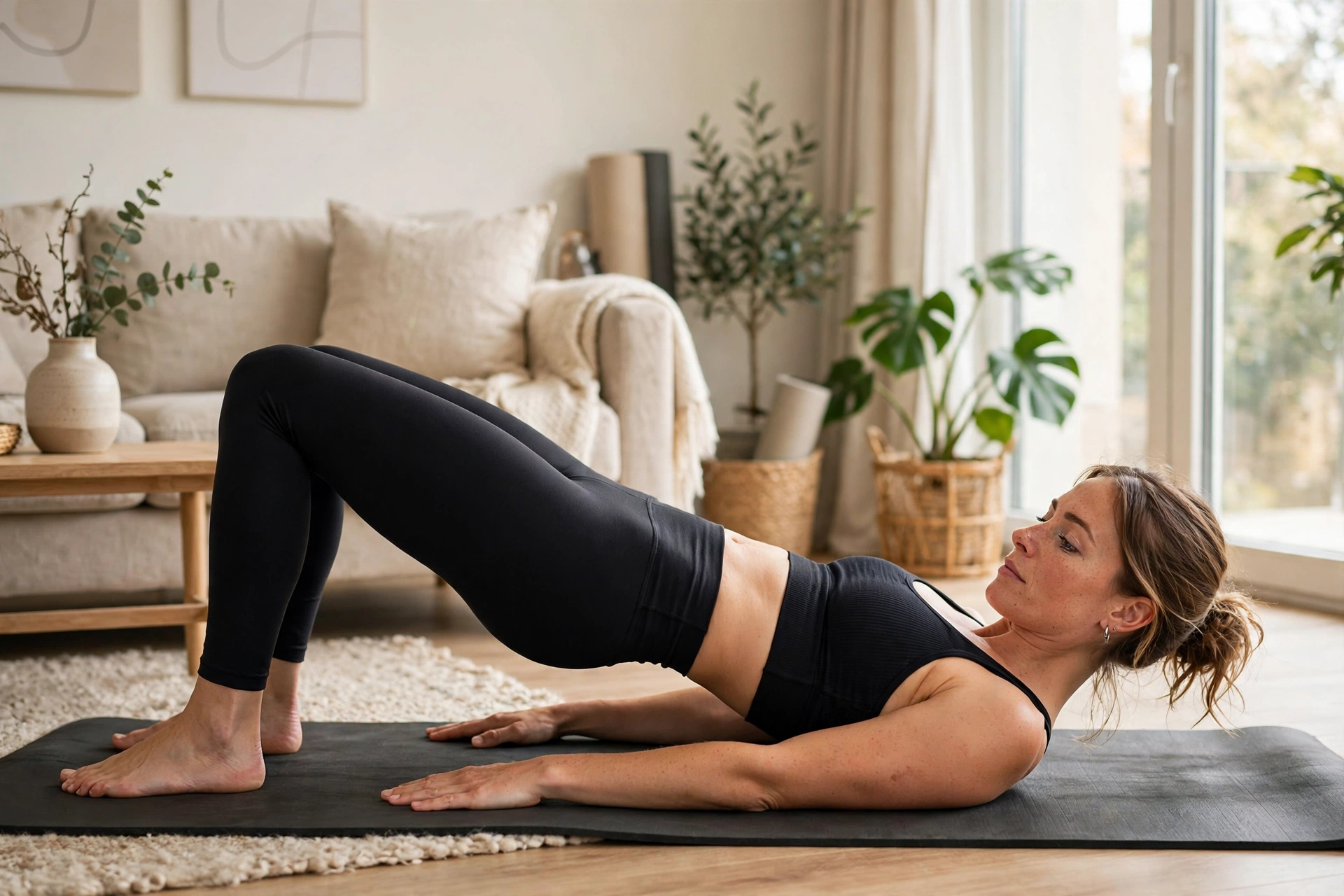
Lie on your back with knees bent and feet flat, hip-width apart. Exhale and slowly lift your pelvis, rolling your spine off the mat one vertebra at a time until your body forms a slope from knees to shoulders. Inhale at the top, then roll back down slowly. Do 8 repetitions. This teaches spinal movement and wakes up your glutes.
2. Chest Lift
Stay on your back with knees bent. Place your hands lightly behind your head. Exhale and curl your head, neck, and shoulders off the mat, keeping your lower back pressed down. Inhale as you lower back down. Do 8 repetitions. If your neck complains, rest your head on a small cushion and lift less.
3. Single Leg Stretch
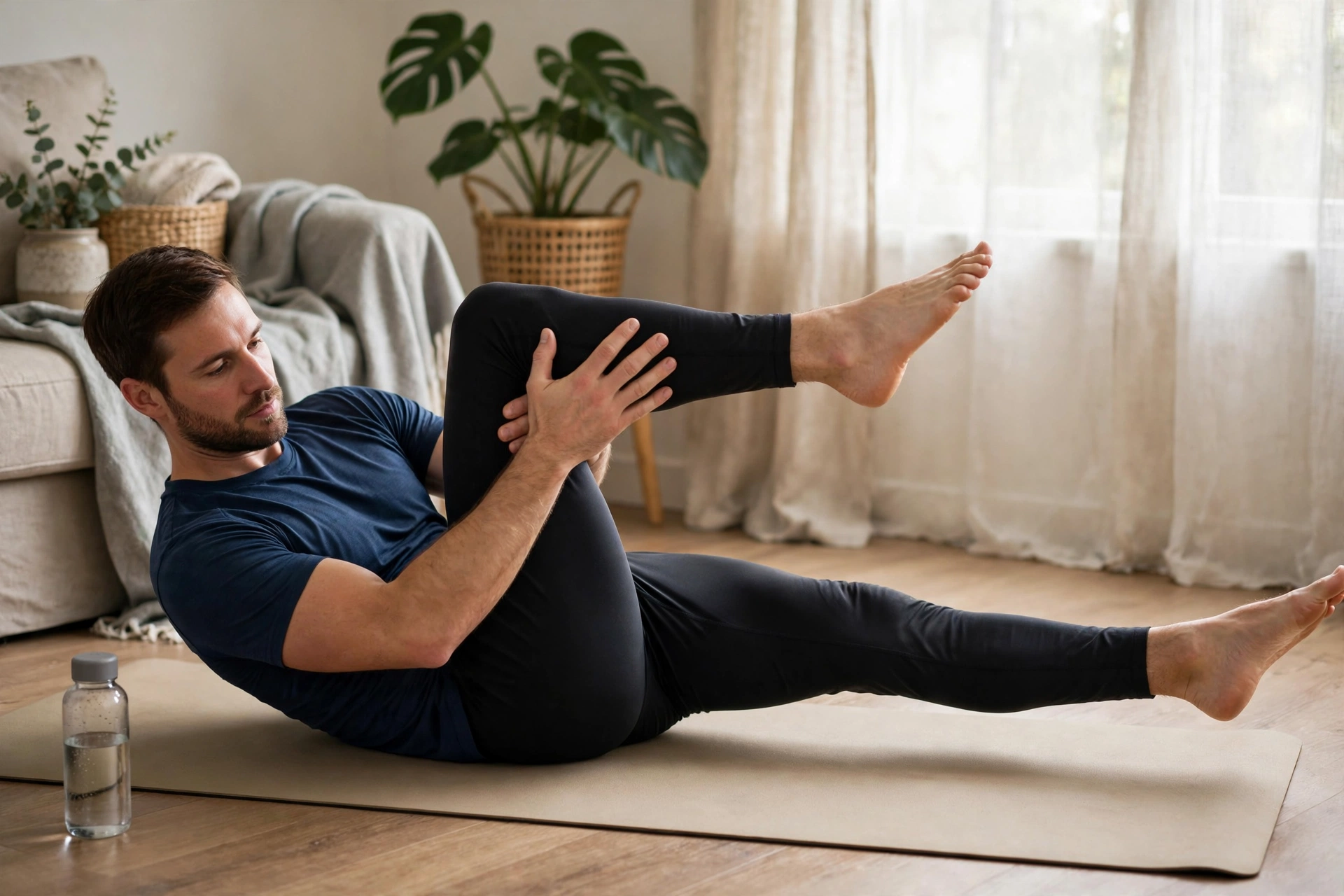
Lie on your back and lift both knees to tabletop, shins parallel to the floor. Pull one knee gently toward your chest while extending the other leg away from you. Switch legs slowly, keeping your pelvis still. Do 6 to 8 repetitions per side. The goal is a quiet pelvis, not fast legs.
4. Leg Circles
Lie on your back with one foot flat and the other leg lifted toward the ceiling, knee slightly bent if needed. Draw small, slow circles with the lifted leg, 5 in each direction, keeping your hips level. Repeat on the other side. Smaller circles with a steady pelvis beat big circles with a rocking body.
5. Spine Twist
Sit tall with legs extended or crossed. Stretch your arms out to the sides. Inhale to sit taller, then exhale and rotate your upper body to one side, keeping your hips facing forward. Inhale back to centre and repeat on the other side. Do 5 repetitions per side. This is gentle rotation, not a forced stretch.
6. Side Leg Lift
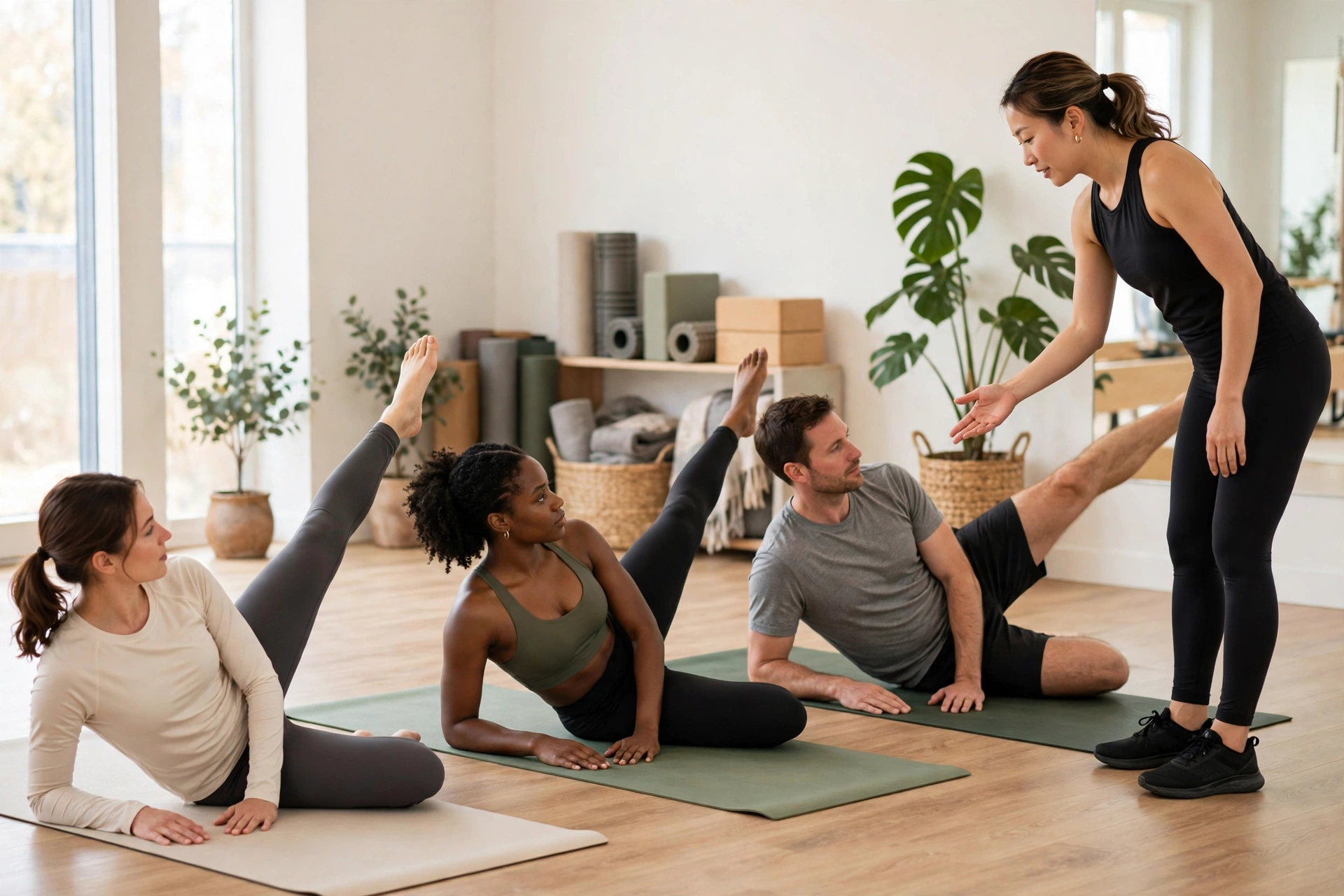
Lie on your side with your head resting on your arm and your legs stacked. Slowly lift the top leg about 30 cm, keeping your toes pointing forward, then lower it with control. Do 8 repetitions, then switch sides. Your waist should stay lifted away from the mat rather than sagging into it.
7. Bird Dog
Come onto all fours with hands under shoulders and knees under hips. Slide one arm forward and the opposite leg back until both are level with your body. Hold for two breaths, return, and switch sides. Do 5 repetitions per side. This one looks simple and exposes wobbly balance immediately, which is the point.
Put together, these seven moves take about 15 to 20 minutes, which is a full pilates for beginners session. You do not need to add more until these feel steady.
A Simple Weekly Plan
Consistency matters more than intensity with pilates for beginners. Two or three short sessions a week will teach your body the movements far better than one long session that leaves you stiff for days.
| Day | Session | Time |
|---|---|---|
| Monday | The 7 exercises, 1 round | 15–20 minutes |
| Wednesday | The 7 exercises, 1 round, slower | 15–20 minutes |
| Friday | The 7 exercises, 2 rounds if ready | 25–30 minutes |
| Other days | Rest, walk, or gentle stretching | As you like |
That rhythm is enough for pilates for beginners in the first month. On rest days, light movement still helps. A short walk or some stretching exercises for beginners will keep stiffness away without adding training stress. After three or four weeks, add a second round or a few extra repetitions before you add new exercises.
Common Mistakes Beginners Make
Most mistakes in pilates for beginners come from rushing or trying to copy an advanced version too soon.
Moving too fast. Speed hides weak control. Slow down until you can feel exactly which muscles are working.
Holding your breath. If you catch yourself holding your breath, the move is too hard right now. Make it smaller and keep breathing.
Chasing a big range of motion. Lifting your leg higher is not better if your pelvis rocks. Small and steady wins.
Pulling on the neck. In chest lifts, your hands support your head. They do not drag it forward. Your abdominals do the lifting.
Skipping rest days. Your muscles adapt between sessions, not during them. Two or three sessions a week is plenty at the start.
Expecting instant results. Most people feel better control in 4 to 6 weeks of regular practice. Posture and strength changes are gradual, and that is fine.
Is Pilates Safe for Everyone?
As a starting point, pilates for beginners suits a wide range of people, including older adults, because the exercises scale down easily. Still, a few groups should check with a doctor or physiotherapist first: people who are pregnant, anyone recovering from surgery or a recent injury, and anyone with pain, numbness, or weakness travelling down an arm or leg. Verywell Health’s beginner Pilates guide gives the same advice, and it is worth following.
During practice, learn the difference between effort and warning signs. A deep muscle burn that fades when you stop is normal effort. Sharp pain, joint pain, dizziness, or pain that shoots down a limb means stop that exercise and get advice if it continues.
Be honest about your starting point. If you have not exercised in years, begin with the easiest versions and build up over weeks. In pilates for beginners, patience beats ambition every time.
That is why pilates for beginners works best when you progress gradually rather than trying to match someone else’s pace. A short, regular routine of pilates for beginners can build confidence without overwhelming your joints or your schedule. If a movement feels uncertain, choose the easier version of pilates for beginners and focus on steady breathing. Over time, pilates for beginners should feel more controlled, even if the exercises themselves stay simple.
Frequently Asked Questions
Is Pilates good for complete beginners?
Yes. Mat Pilates was designed to be scaled, so pilates for beginners starts with small, supported movements and adds difficulty only when your control improves. You do not need any fitness background to begin.
How often should a beginner do Pilates?
Two to three sessions a week, 20 to 30 minutes each, is a sensible start with pilates for beginners. Once a week still helps, but two sessions teach the movements noticeably faster.
Do I need a reformer to start Pilates?
No. Mat-based pilates for beginners uses only your body weight and a mat, and it teaches the same principles. A reformer can help later, but it is not a requirement for starting.
Can Pilates help with back stiffness?
Many beginners find that stronger deep core muscles and better spinal movement make everyday back stiffness feel more manageable. Pilates is exercise, not medical treatment, so ongoing back pain should be checked by a professional.
How long until I see results from Pilates?
With pilates for beginners, most people notice better control and posture within 4 to 6 weeks of regular practice. Visible strength changes take longer, usually 2 to 3 months of consistent sessions.
Disclaimer
This article is general educational information about exercise and is not professional, medical, or financial advice. Exercise guidance, class prices, and health recommendations change over time and vary by country and provider, so please verify important details from official sources and speak to a qualified professional about your own situation before starting a new exercise routine.